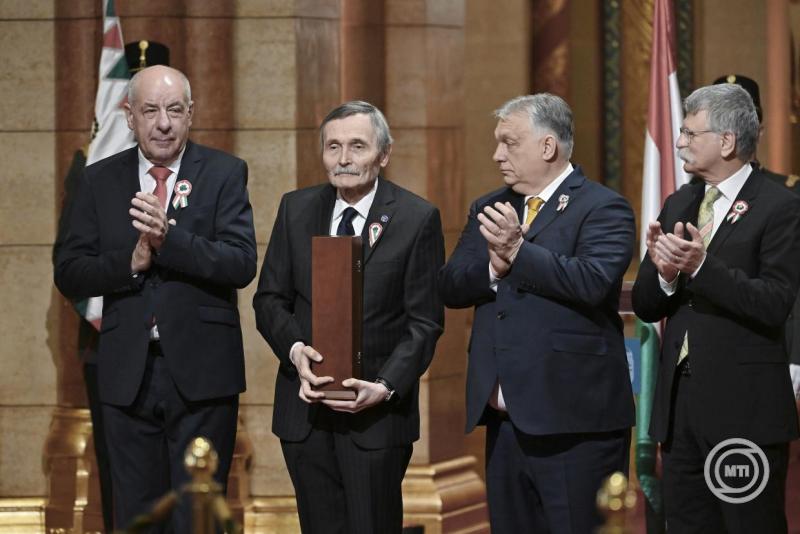
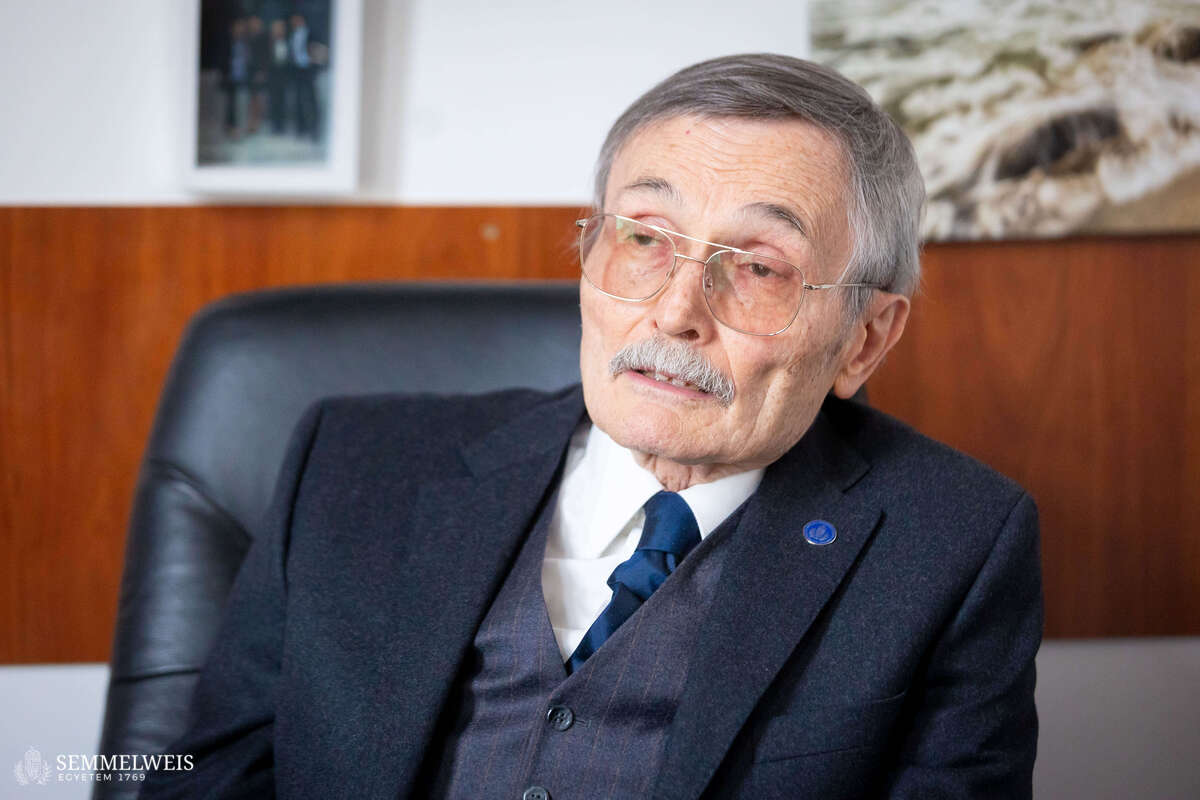
 “There have been many noteworthy milestones in my life. But perhaps none can compare to the moment when, upon entering the main entrance of the Hungarian Parliament Building, I walked up the red carpet of the magnificent staircase, stood beside the Holy Crown of Hungary, and took my seat among the honorees. “It was an uplifting experience!,” recalled Dr. István Gera, describing the moments leading up to receiving the Széchenyi Prize, a recognition awarded by the state for outstanding contribution to academic life in Hungary. He added that it was a source of immense joy for him to receive this honor as a clinician and indeed, as the first dentist, especially since Dr. Zoltán Zsolt Nagy, Director of the Department of Ophthalmology, and Nobel laureate Dr. Ferenc Krausz were also honored that same year. At a ceremony held in the Hungarian Parliament Building, Dr. István Gera received one of the nation’s highest honors from President Tamás Sulyok, Prime Minister Viktor Orbán, and László Kövér, Speaker of the National Assembly.
From the very moment I entered this university in 1967 until I received the Széchenyi Prize on March 14, I felt that my life had been guided by a series of fortunate coincidences. – Dr. István Gera
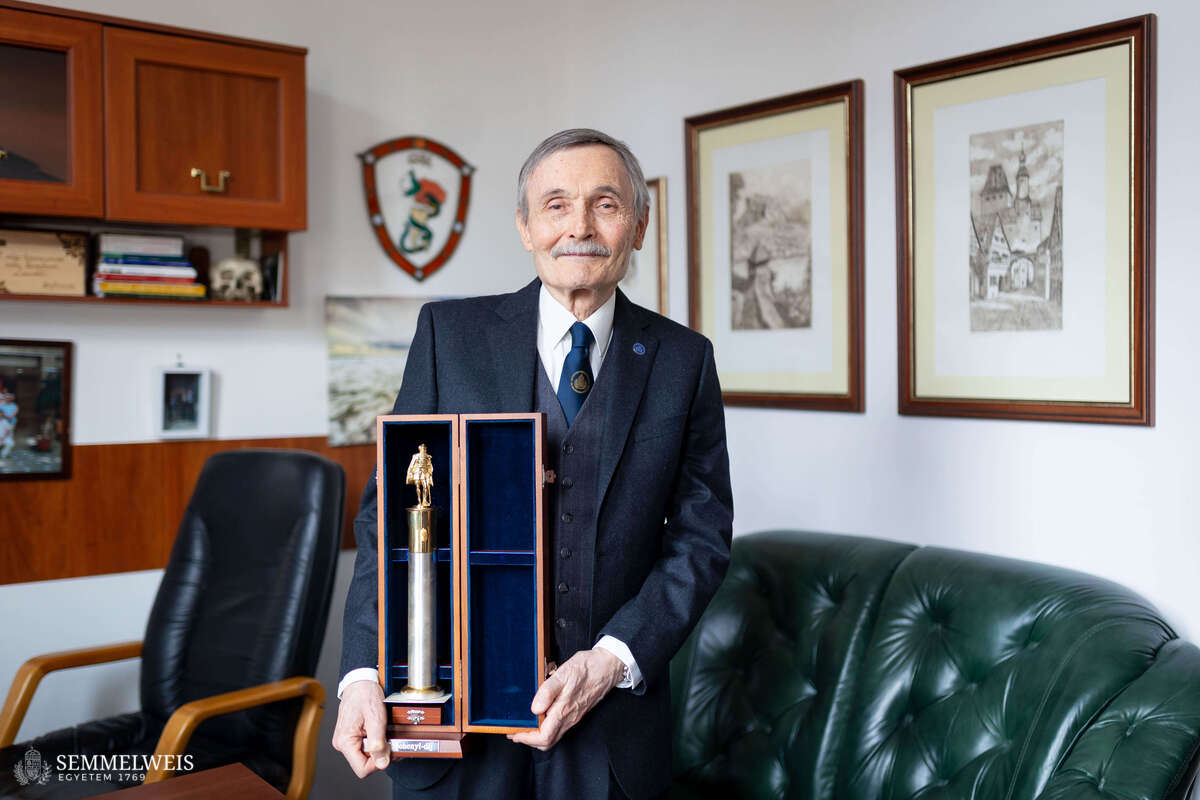
He was born in Szeged in 1949. His career choice was significantly influenced by the fact that, during the first decade of his life, he spent nearly a year in hospital. “I was introduced to hospital life, the work that goes on there, and the doctors and nurses at an early age. That’s what inspired my decision to become a doctor. At first, I wanted to apply to medical school. But, since I’ve always loved drilling and carving, I decided to apply to the Faculty of Dentistry at the last minute,” he recalled. In 1967, he was admitted to the Faculty of Dentistry (FOK) at the then Medical University of Budapest (BOTE). He received his degree from Semmelweis University of Medicine (SOTE) in 1972 with summa cum laude honors. He won several academic competitions, served as an award-winning teaching assistant and was actively involved in the university’s community life.
“I was determined to work in a hands-on field, specifically in dentoalveolar surgery, and I was even accepted as an intern there. However, at the end of my 10th semester, Professor Béla Berényi, the Dean of the faculty, informed me that I would be working in the oral diseases section of the Department of Oral Surgery. “That’s how I ended up in this department, which at the time had a distinct focus on internal medicine; they primarily dealt with diseases of the oral mucosa here. The course in periodontology was also taught in this department,” he recalled, describing how he found his chosen field. “When I started working in the oral disease section, Dr. Kornélia Sallay called me in and asked me what I wanted to specialize in. I had already chosen periodontology by then. However, she replied that there was no scientific evidence for this, so what was I supposed to do with that? She suggested that I focus on drug-induced dry mouth and other diseases of the oral mucosa. But I missed the hands-on surgical work. I began leafing through the bound volumes of the Journal of Periodontology from ’53 to ’73, which virtually no one in the department was reading. Back then, not even the educators were particularly interested in periodontology. While reading these, I noticed that 40-50 new periodontal surgical techniques – along with their clinical results – had been published in the journal. I asked Dr. Kornélia Sallay whether we could perform these surgeries ourselves, since the papers indicated that they could effectively treat periodontal disease. Before long, we had co-authored our first periodontology handbook, followed by the textbook,” noted Dr. István Gera.
The first Periodontology Congress was held in Gödöllő in 1977, attracting experts from all over the world.
In the early years, the department’s doctors learned increasingly complex surgical procedures almost entirely on their own, step by step; they published numerous articles on these procedures in Hungarian journals and gave a series of scientific lectures. “Periodontology is the bedrock of dentistry,” believes Dr. István Gera.
He added that the discipline had undergone tremendous development; back in the 1970s, 1980s, and 1990s, only a slim volume summarized the relevant findings and research. Today, a textbook of more than 650 pages has been released by Semmelweis Publishing, now in its third, expanded edition. Dr. István Gera served as the editor-in-chief for all three of them.
The next milestone in his career was his study trip abroad. “Dean Dr. Imre Vámos passed away suddenly and unexpectedly in the spring of 1980. His successor was Dr. György Szabó, who came from Szeged; he was a professor who had already seen the world, was internationally recognized, and was exactly ten years older than me. He had barely assumed his position when he called me in: ‘I’ve heard about you in Szeged; you’ll have to go abroad too!’ However, I owe the scholarship not to him, but to Dean Jolán Bánóczy. She spent a month at the University of Connecticut (UCON) at the invitation of the world-renowned Norwegian scholar Harald Löe, who was the Dean of the faculty at the time. “When the dean returned home in August 1982, she called me to ask if I would be interested in going to America for two years. I couldn’t turn down that offer,” recalled Dr. István Gera. However, he could thank Professor Klaus Nuki, a vice dean of Austrian descent with Hungarian roots, for the scholarship itself: he had the opportunity to spend two years as a dental resident and two semesters as a visiting researcher at the university. “In the end, I also owe it to Professor Nuki that I was able to join the research group of a wonderful endocrinologist, Dr. Larry Raisz, who is also of Hungarian descent. I started working part-time in Professor Janet Hock’s laboratory here as early as January 1984, and I continued this research work as a colleague of Dr. Hock until August 1988,” he noted.
 His scholarship ended in 1988, but he continued to participate in research until 1992. As a follow-up to this, Janet Hock, then Vice President of Research at Eli Lilly and Company, registered the low-dose parathyroid hormone fragment (hPTH-1-34) as a drug for human use in the United States in 2000 – this medication for osteoporosis is still available in Hungary today. “From the very beginning – starting with animal trials – we have come to develop a registered drug, and I was able to participate in its research program – despite being a dentist, a resident, and a Hungarian,” he pointed out. Regarding his study abroad, he highlighted the role played by his wife, Dr. Etelka Varga: “She endured my long absence, visited me several times, but she was the one at home when my godmother or my grandmother passed away. I can’t thank her enough for holding down the fort! As the saying goes, behind every successful man there stands a strong woman – and that’s certainly true in my case.”
During his time in the United States, Dr. István Gera learned that one must maintain high standards in one’s work under all circumstances. “Working in the U.S. was a major challenge. It was there, in 1983, that I first encountered a computer and numerous instruments I had never seen back home.” They really instilled this ‘quality dentistry’ mindset in us: They checked the accuracy of the impressions under a microscope, and if the probe got caught on the edge of the trial crown, the boss would immediately come over and say, ‘István, do it again!’ That’s exactly why, when people asked me after I had returned home if there was a difference between American and Hungarian dentistry, I always said: “It’s just as much as there is between the production of an East German Trabant and the production of a Mercedes,” he emphasized.
Returning home, Dr. István Gera joined the English-language dental training program in 1991 and was appointed vice dean in 1992. He considers the greatest breakthrough in his professional career to have been his habilitation in 1996, based primarily on the results published in American bone research journals. A year later, he was appointed professor. That same year, he became the first professor at the Department of Periodontology, which had been established at the recommendation of Dean Dr. Pál Fejérdy. “To this day, it remains the only independent periodontology clinic in Hungary. An internationally recognized research team has evolved at the clinic, and outstanding research projects have been and continue to be carried out here,” he noted. He served as dean of FOK for two terms, from 2004 to 2010. Alongside Jolán Bánóczy, he served as secretary-general and later as president of the Hungarian Dental Association (MFE); he also rose from secretary to president of the Hungarian Society of Periodontology, where he was later elected president for life. He has received numerous state and university honors, including the Árkövy Commemorative Medal, the Hungarian Higher Education Commemorative Plaque, the Knight’s Cross of the Order of Merit of Hungary (Civil Division), the Pro Universitate Award, the Semmelweis Ignác Commemorative Medal and Award, and the Pro Universitate Lifetime Achievement Award.
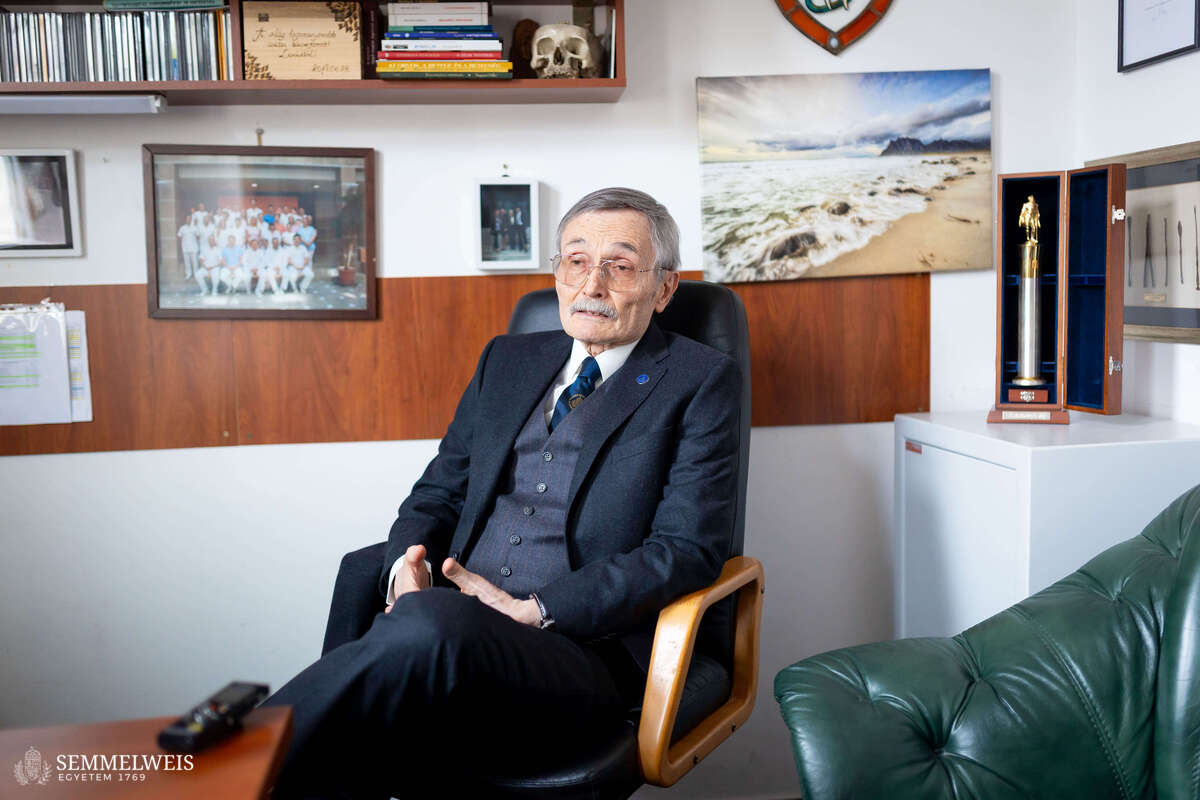
“My patients are practically like family to me, because in periodontology, a successful case means a lifelong relationship between doctor and patient. I have many patients in their 80s and 90s who have managed to keep their teeth well into old age thanks to ongoing treatment. Semmelweis University is my second family. “I’m 77 years of age, I get to work in excellent conditions, I still see patients in my office, and I’m involved in teaching – I love giving lectures! I owe everything to the university: my scholarship to the U.S., becoming a professor, and even being able to establish a department,” he emphasized.
Ádám Szabó
Translation: Judit Dőtsch
Photos by Boglárka Zellei – Semmelweis University; MTI