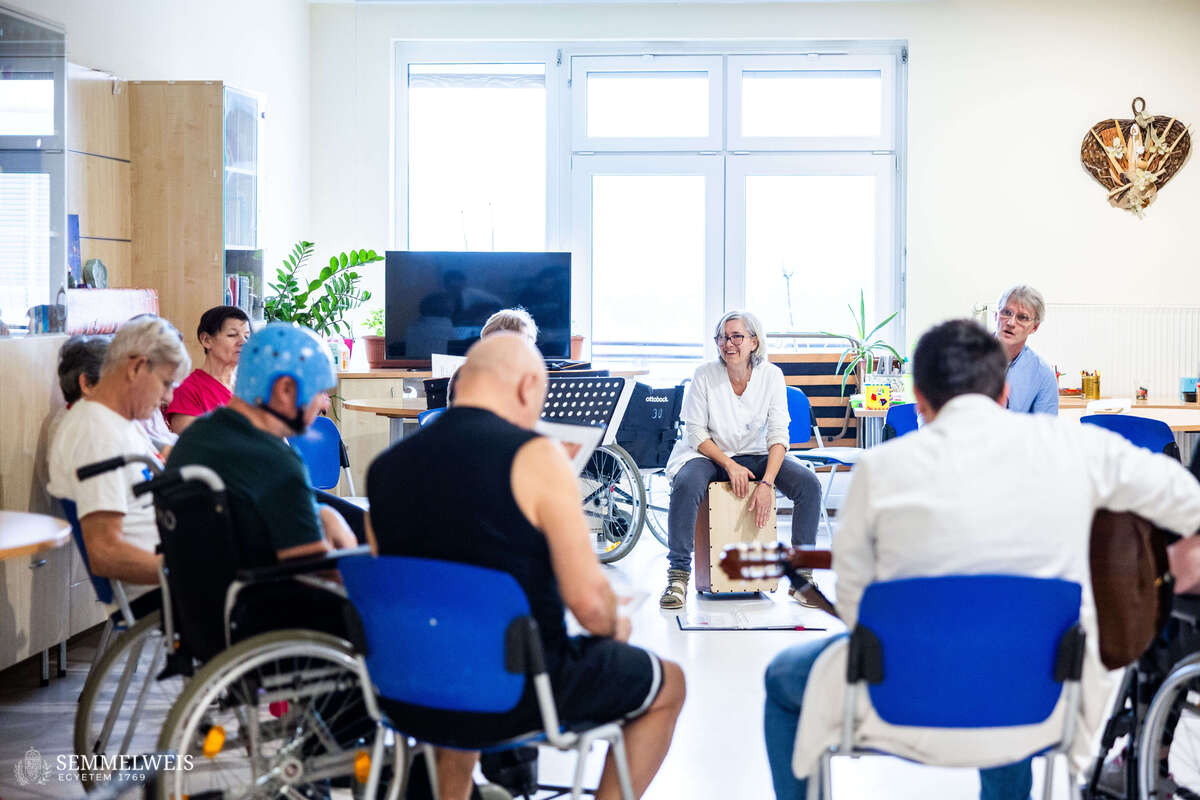
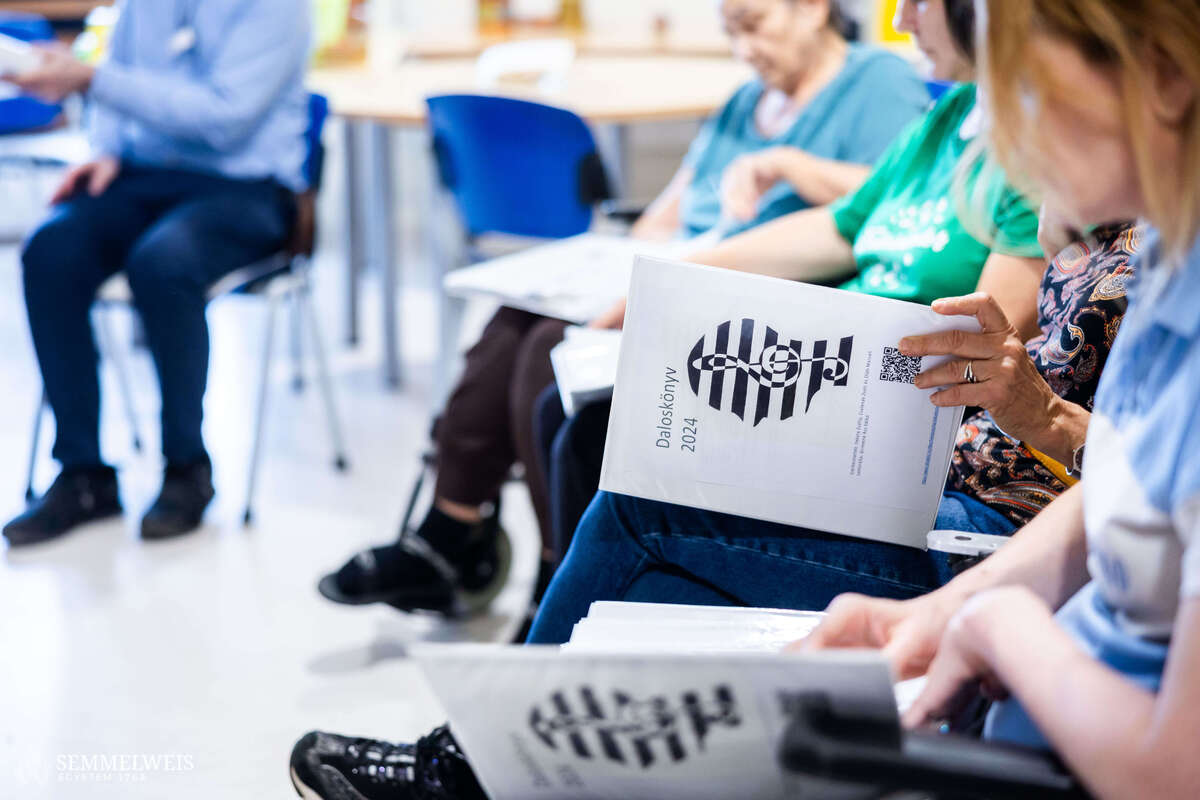
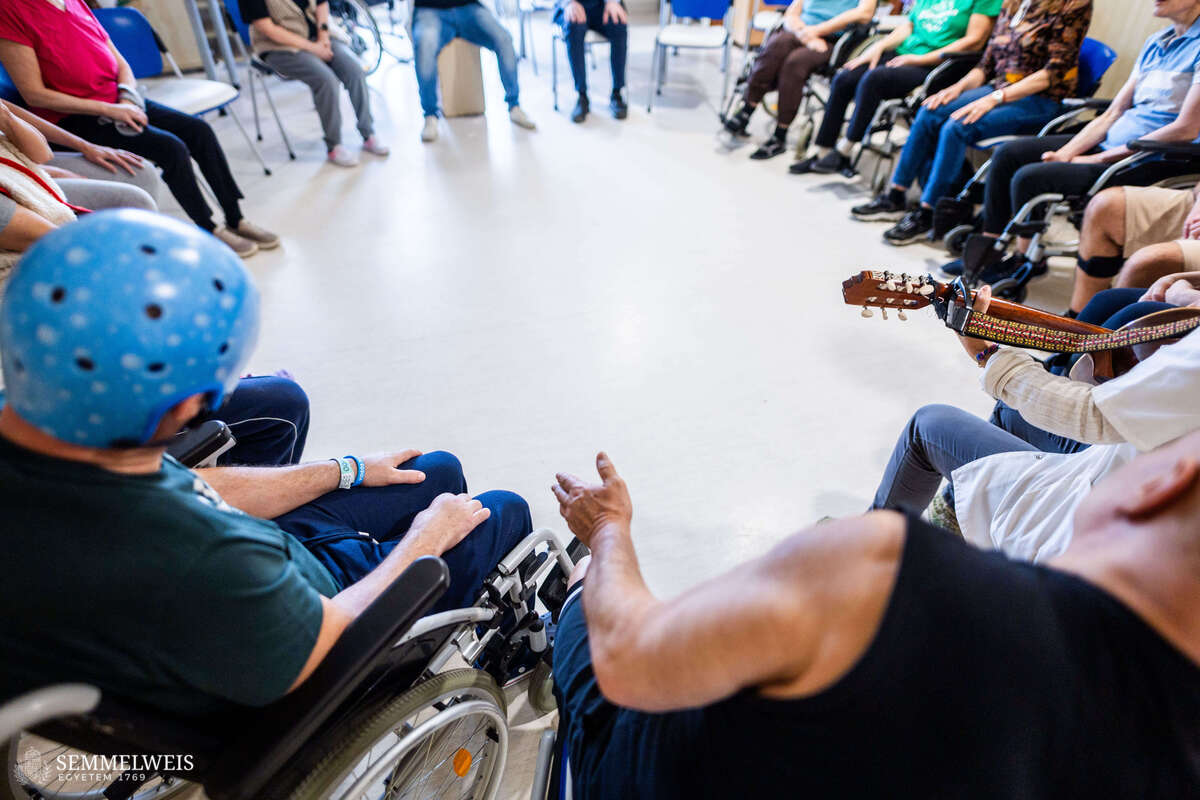
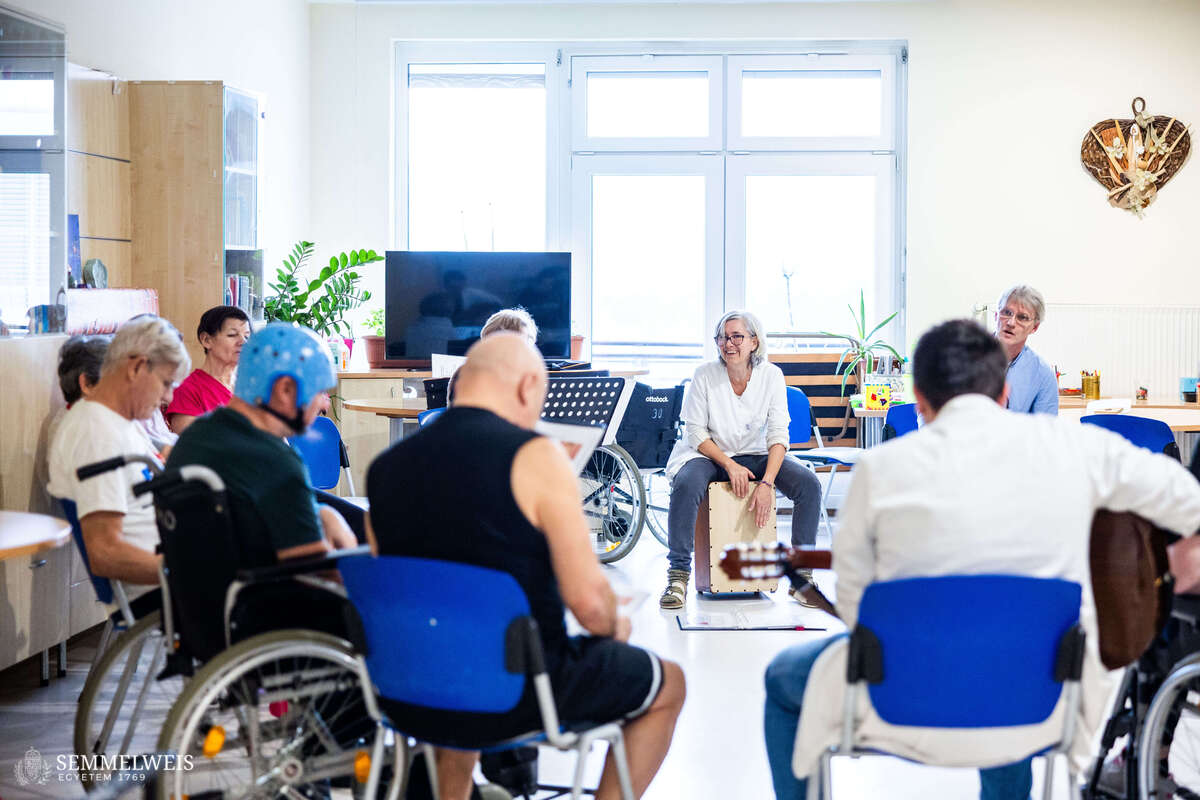
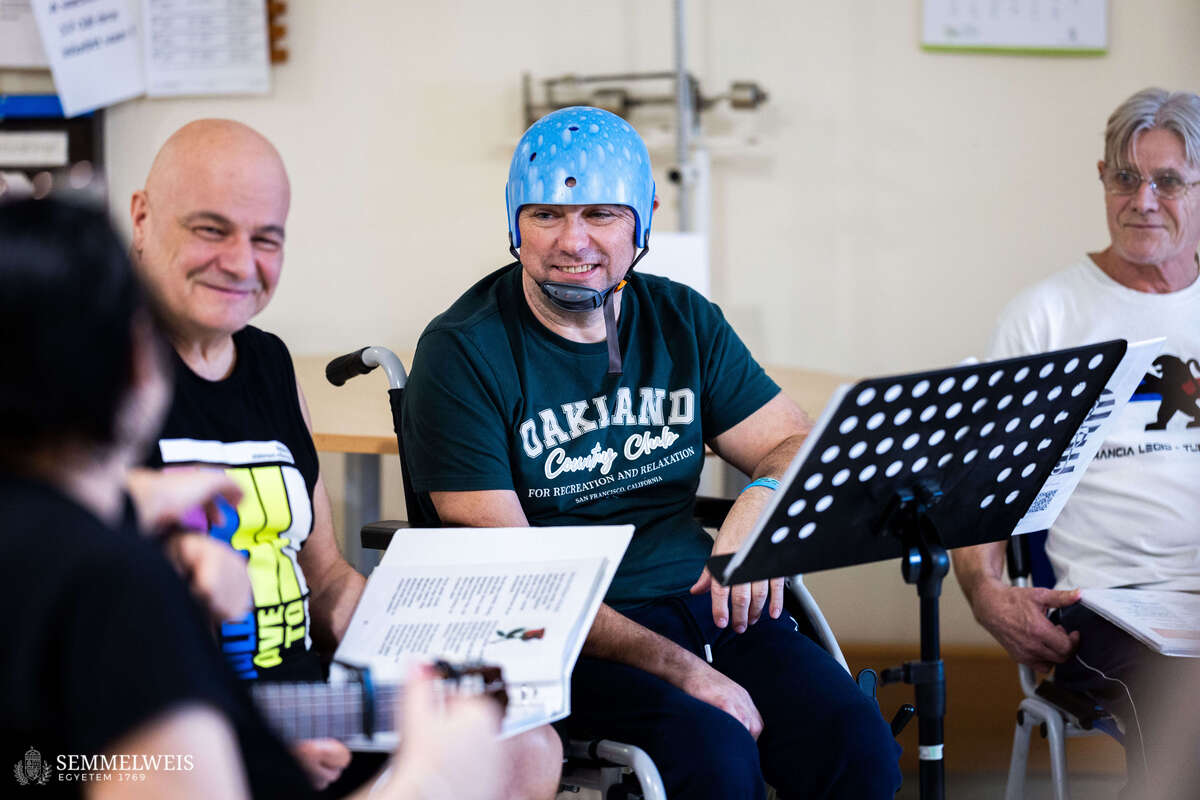
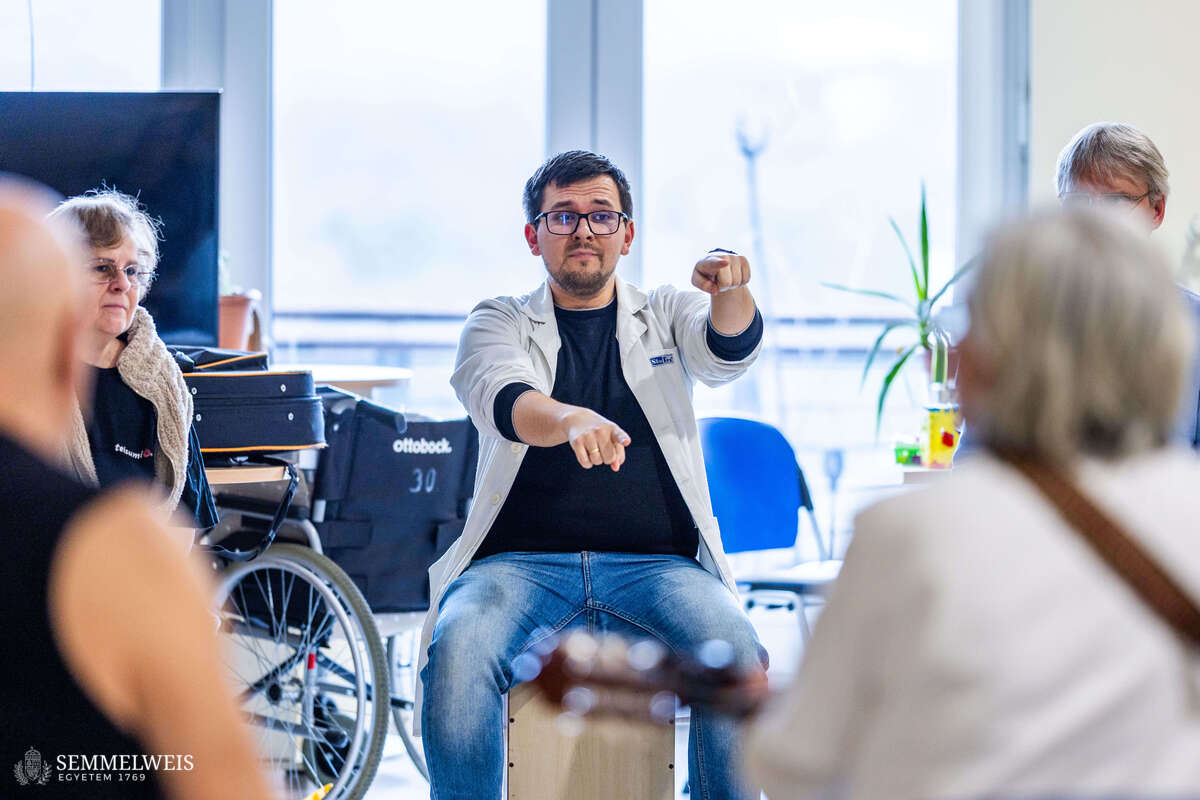
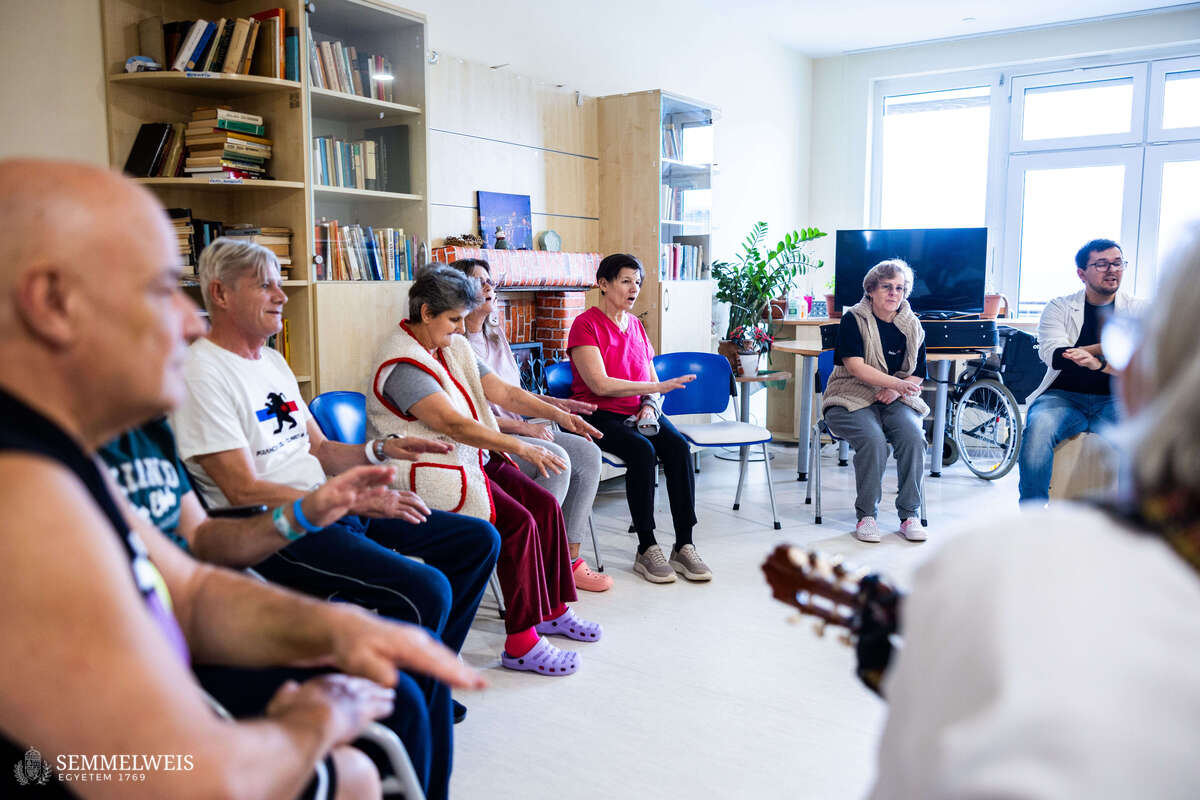
“We’d like to ask you to hum the following song with us. If you recognize it and know the lyrics, please don’t say them yet because we’ll be doing some articulation exercises first,” asks Zsófia Fekete, guitar in hand, of those sitting around her. She then turns to the man sitting next to her and asks him to say a vowel. He struggles to produce the requested sound, until Zsolt Cselenák gently guides him to the note E, which he can now hold steadily. Then, turning to the other patients sitting in the circle, he invites them to sing the note E together and tap their feet to the rhythm. Accompanied by Zsófia on guitar, about a dozen patients from the department’s Stroke Rehabilitation Ward clap their hands, stomp their feet, and hum a Hungarian folk song together in the E key.
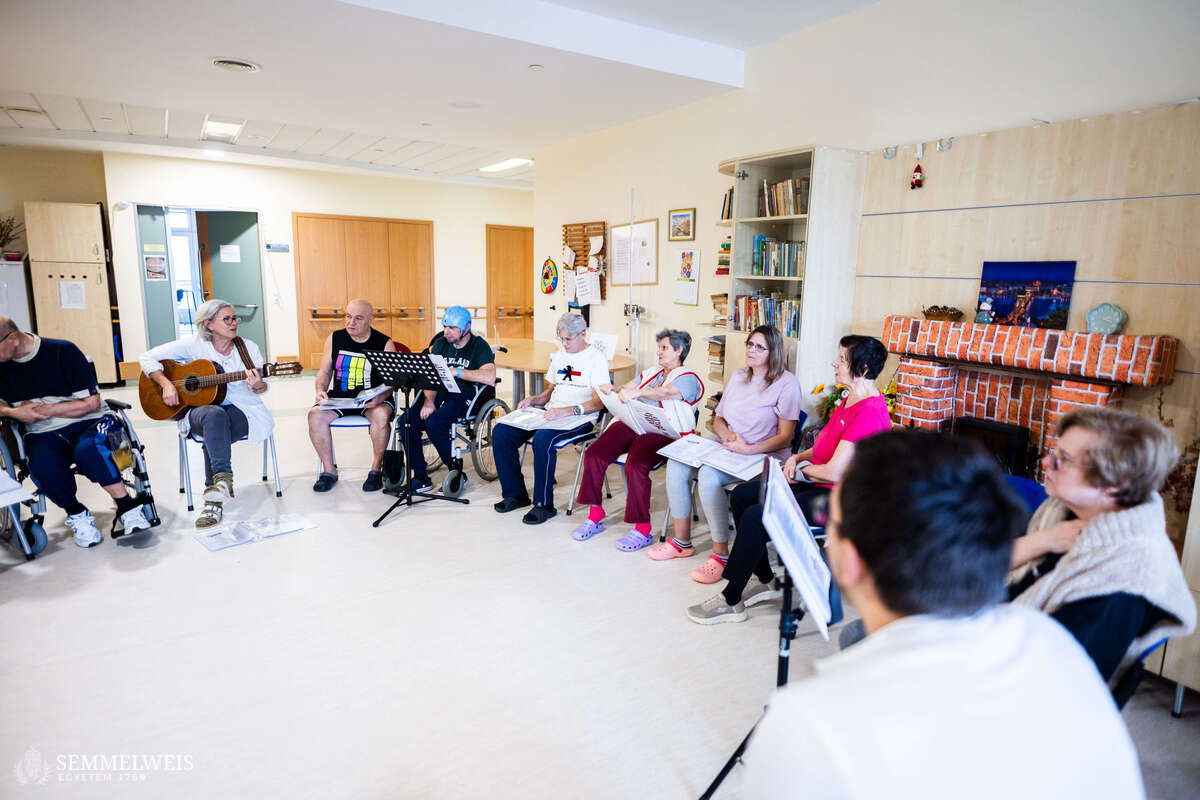
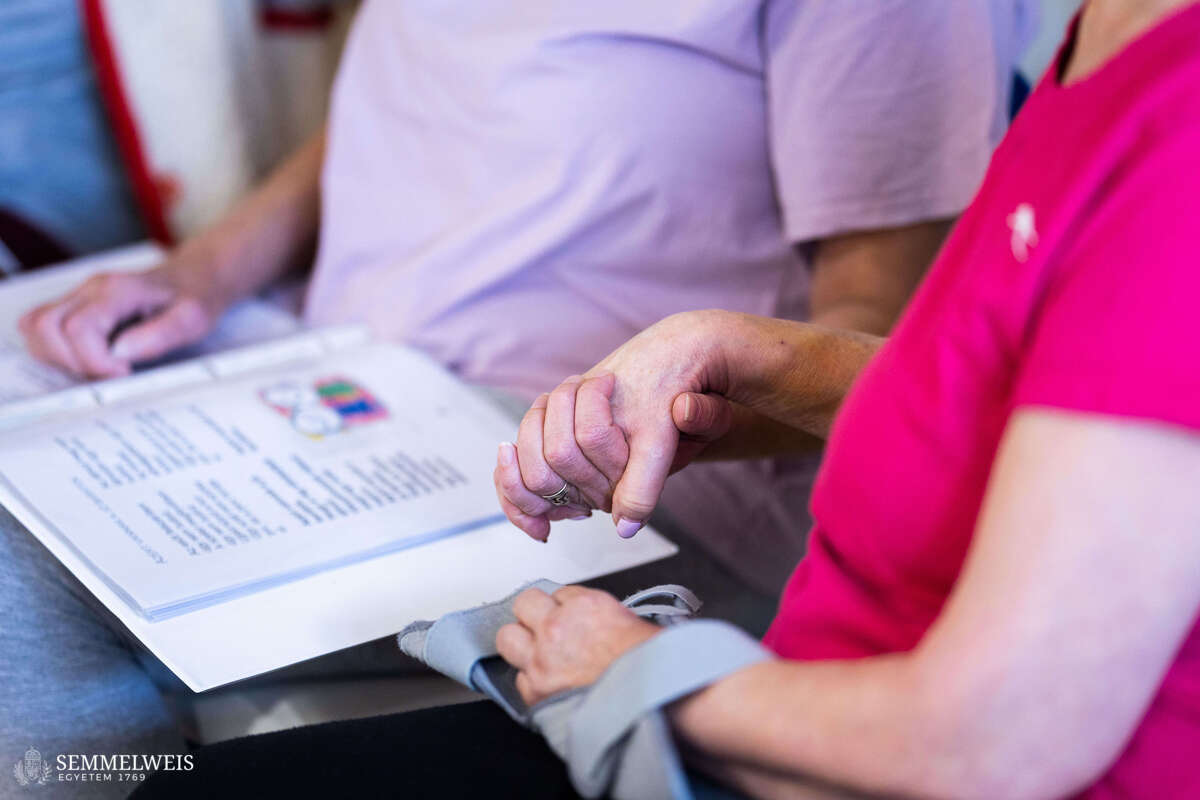
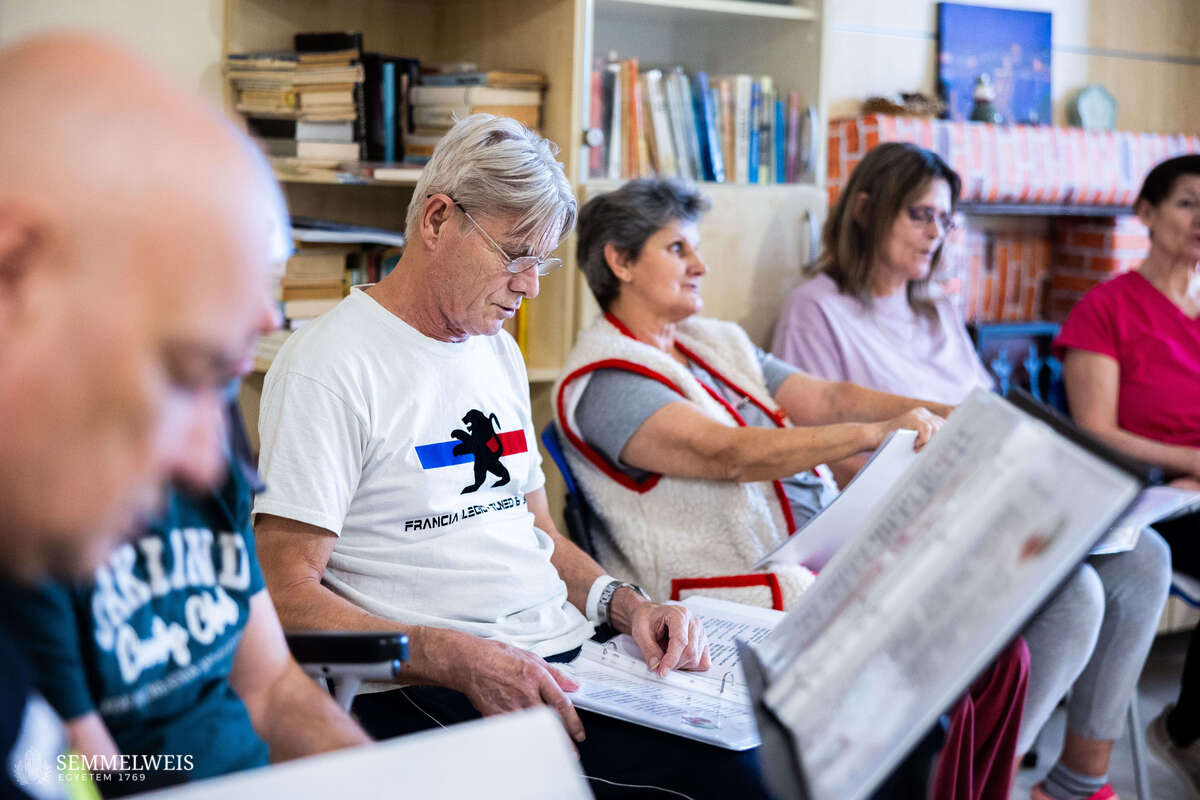
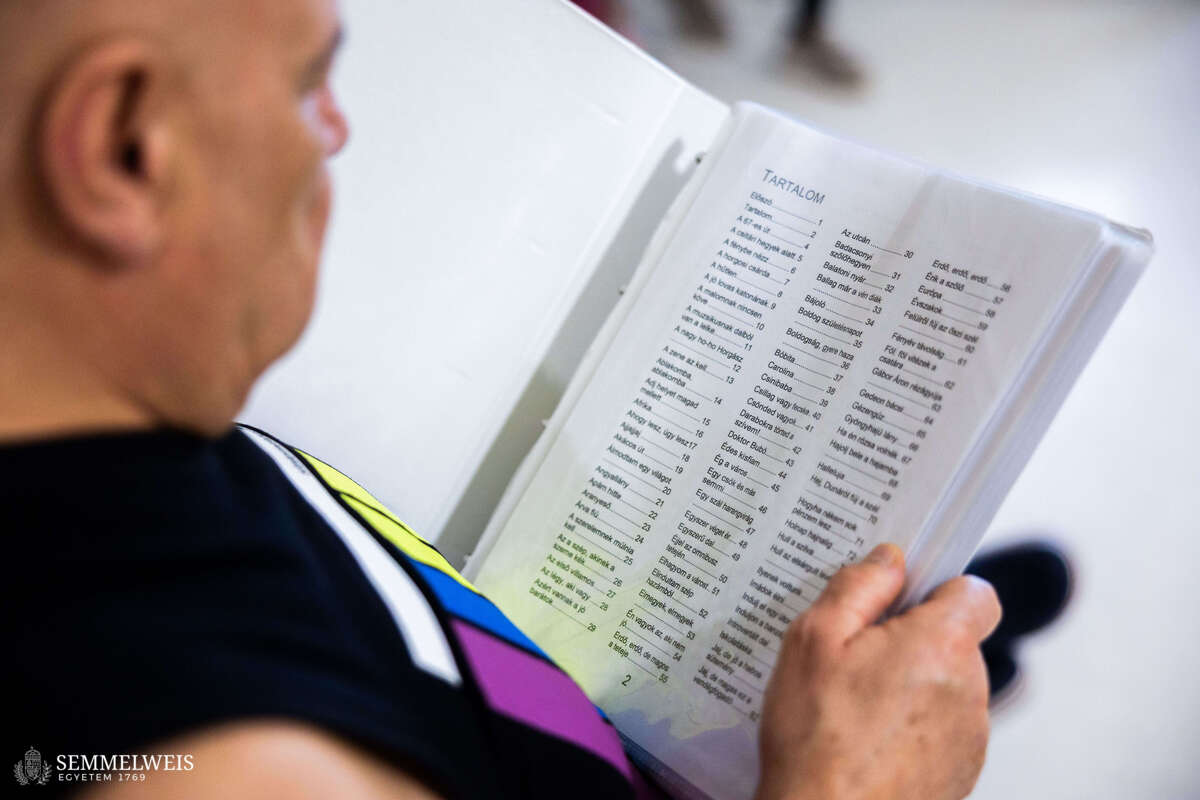
They continue humming the same folk song, but now with a different note provided by another patient, and at Zsolt’s request, they move their arms and legs in a criss-cross pattern. The patients, who are struggling with remaining symptoms and aphasia following their strokes, then take turns trying to say the lines of the song, after which Zsolt leads them in breathing exercises. This is followed by group singing at an accelerating pace, and the sole prop of the music therapy sessions is brought out: Zsófia and Zsolt’s 160-page songbook, compiled over many years of work, which everyone clearly knows well and which offers a wide selection ranging from folk songs to pop hits, so that everyone can find something to their liking.
During the session, everyone can share how they feel: Formulating a response is difficult for many, but when it comes to talking about the songs, communication becomes easier – even for those who previously kept silent. As they sing each song, Zsolt evokes the atmosphere of a campfire, which seems to fill many with a sense of well-being; tension eases, and speech begins to flow.
The beginnings of music therapy
The history of music therapy for people with aphasia goes back to the 18th century. In 1736, a Swedish physician, Olaf Dalin, noticed that a young man who had lost his ability to speak following a brain injury sang psalms in church with perfect articulation. This seemingly inexplicable phenomenon has been observed by many therapists working with aphasia patients. In most people, the neural networks responsible for verbal function are located in the left hemisphere of the brain; it is no coincidence that the majority of aphasia patients have left-sided brain injuries. However, singing – due to the complex interplay of pitch, intonation, rhythm, and other musical elements – activates the brain more symmetrically. Thanks to this, even those who cannot speak may be able to sing, as the task involves intact areas of the brain as well.
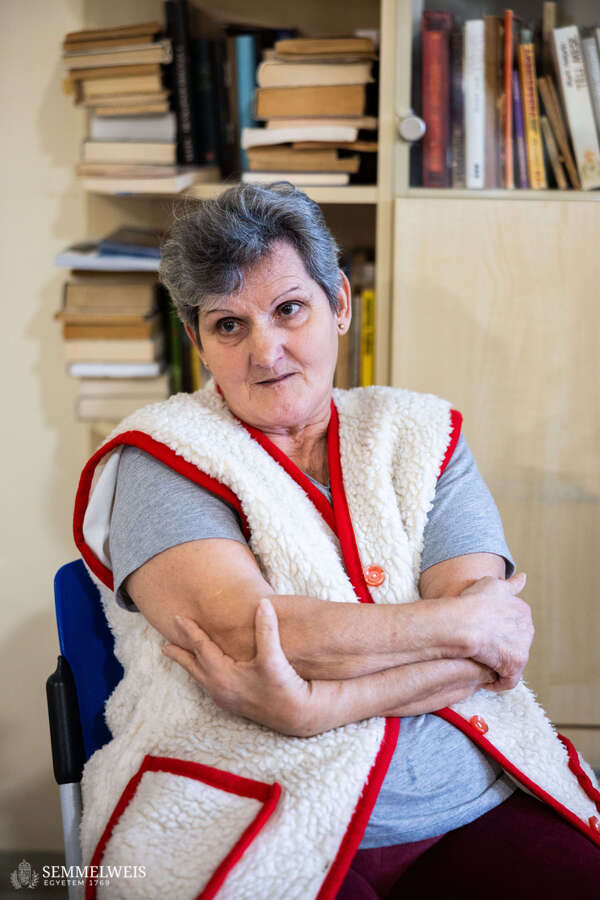
The session is slowly coming to an end, and a few people stay behind to chat with us. Zsóka tells us that the weekly music therapy brings the group together, and that the music and vocal exercises are a great help even to those who haven’t had much trouble with speech following their stroke. Márta mentions cheerfulness, and the group music therapy helps attune the participants to this mood. It feels good to prepare for these occasions, for seeing the happy faces and singing together, as all the inpatients of the rehabilitation ward say in agreement.
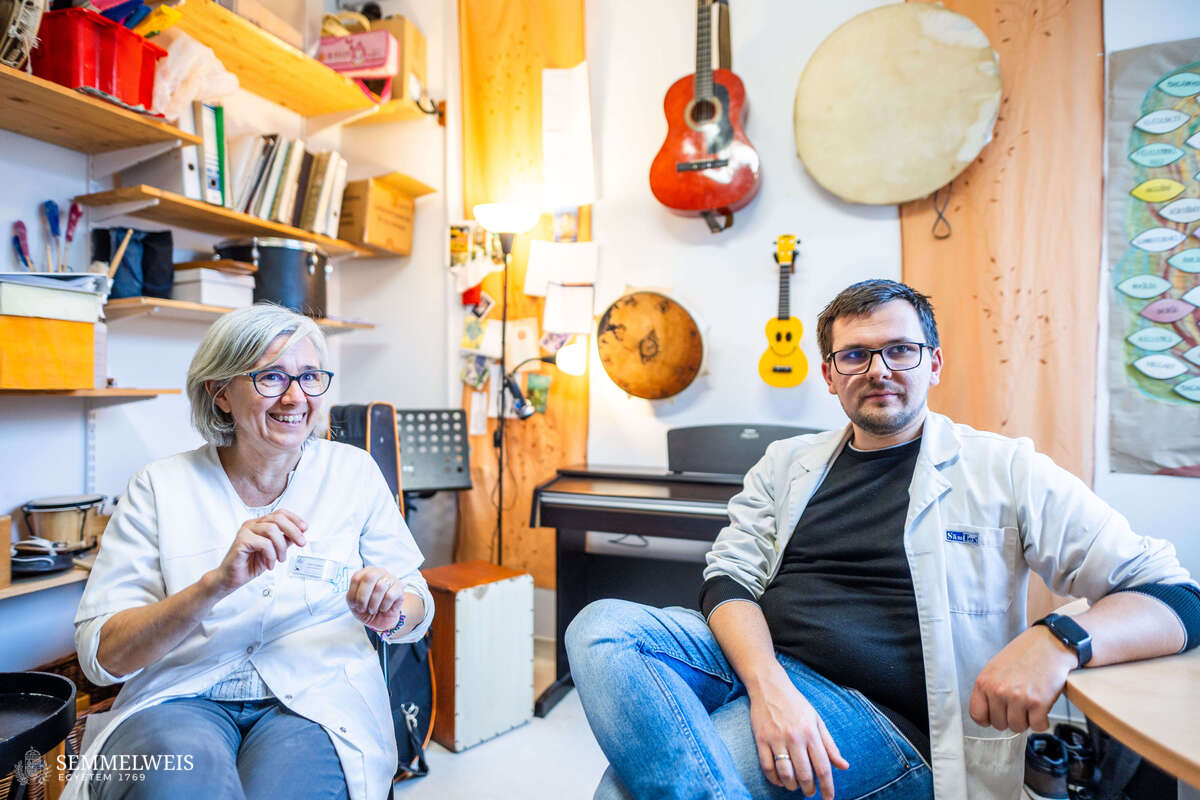
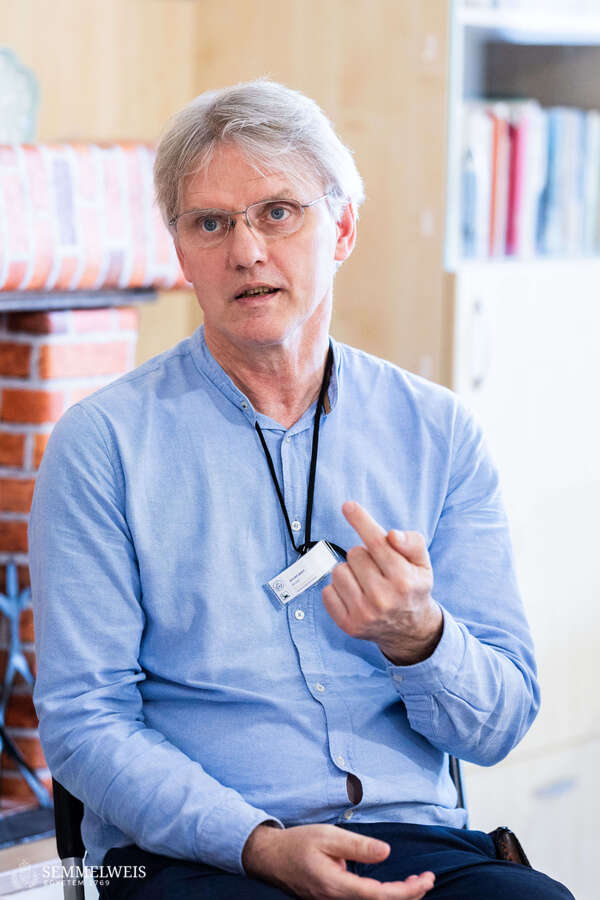
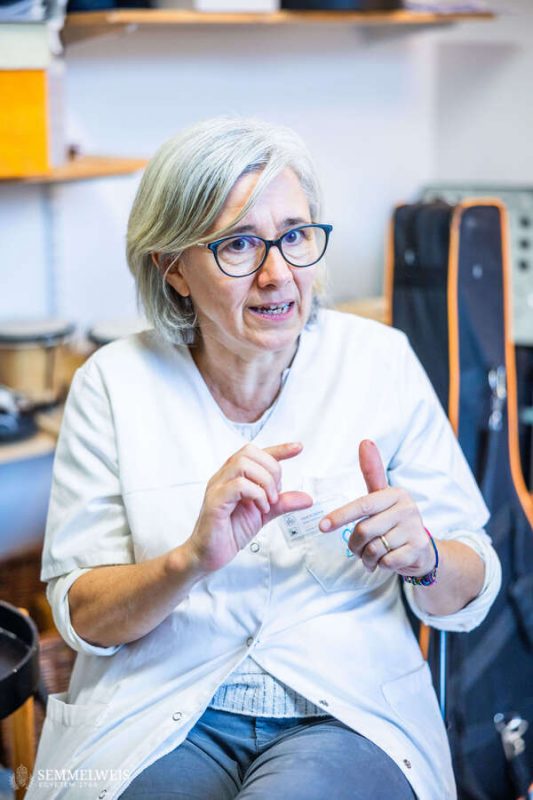 “Music, as an art form, cannot be standardized like a chemical compound or a painkiller since its effect is different for everyone even if we play the same music every time; however, it takes effect immediately at the level of the unconscious,” explains Zsófia – who has been practicing music therapy at the department for nearly 30 years – a little later in the music therapy room. “At the beginning of the session, even before the instructions to move are given, the patients start stirring; and when they hum, the flow of emotions begins. We try to bring these feelings to the surface and make them conscious,” she adds. “Not to mention that in a session like this, it’s not just the music, but also the fact of being together, the therapeutic relationship, and the therapeutic space that have an effect,” Zsolt notes.
The repertoire collected in the songbook over many years of work comes up in every group session, and as the therapists explain, it happens that someone holds onto a song they have chosen from it for weeks so they can sing it together with the group when they say goodbye. But there are also instances when emotional walls and blocks are built around a particular song, which the healing process helps to break down. “During therapy, the possible reason for this is also discussed. It’s important that this inner, mental content – resources, memories, and feelings – should somehow be emphasized and brought into focus. Just as one must learn to walk or speak again, one’s emotional life must also be stabilized anew,” Zsófia and Zsolt agree. The music therapists believe that songs can offer people a lifeline or help them get back on their feet even in very serious situations or crises.
“Sometimes the song itself is the help; at other times, it’s the glance exchanged while singing, or a handshake. And it’s important for us to pay attention to these things, to amplify them, to make them conscious, to reflect them back,” they say. “To perform an impaired movement – in addition to muscle strength – you need mental strength and coping strategies, and music is a tremendous help in all of this,” they point out.
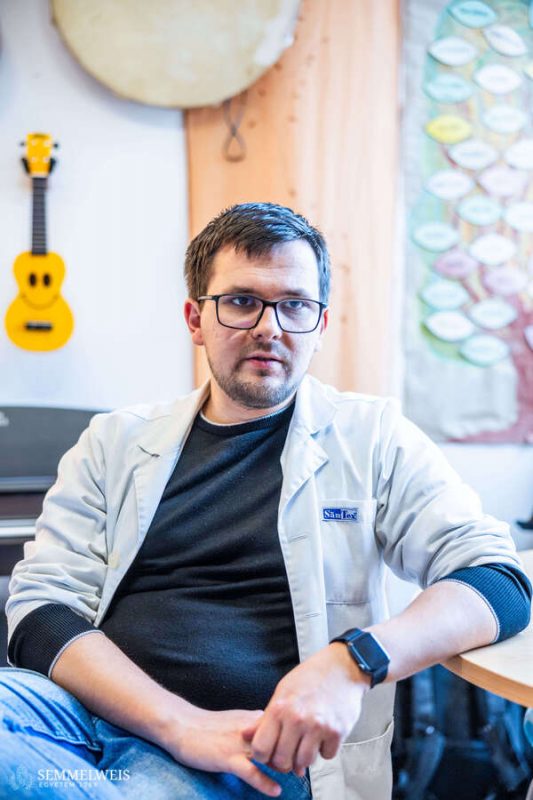 “Most of our patients have aphasia, but we also see people from the septic and trauma wards coming in for individual music therapy who have no speech impairment at all,” Zsolt explains. For them, this is a supportive, resource-building process, perhaps even a form of trauma processing, which functions as a kind of complementary therapy.
Zsófia and Zsolt transitioned from being musicians to becoming music therapists, and they assert that this background strongly shapes their approach to music therapy. In Zsolt’s words, this means they use music – and all its elements – as native speakers use their language. Zsófia puts it more philosophically, defining music as a kind of faith.
“Broad-spectrum music therapy can be practiced in every stage of life, from before birth all the way through to hospice care,” the music therapists assert, adding that it is not always easy to integrate it organically into processes; it does not work at the push of a button, and it takes a long time for it to be accepted. In any case, their clinical groups operate with a large number of participants, and individual sessions also take up the three music therapists’ time (their third colleague, Marcell Oláh, was on leave at the time of our interview).
Gallery
Award-winning Hungarian film on music therapy for people with aphasia
A documentary titled Hangok fogságában (Captive to Sounds) about aphasia and the Hungarian Aphasia Association was filmed by Zsuzsa Dessewffy, a former patient of Semmelweis University’s Department of Rehabilitation who is a film professional and herself aphasic. The film was a huge success at the 11th International Special Film Festival held on November 8, 2025, and Zsuzsa Dessewffy – as the director of Hangok fogságában – won the Best Hungarian Film award for it. The film aims to show how people with aphasia cope with life’s challenges in the absence of verbal communication, and how music and art therapy can help develop and bring back to the surface an ability once thought lost.
Anita Szepesi
Translation: Dr. Balázs Csizmadia
Photos by Bálint Barta – Semmelweis University