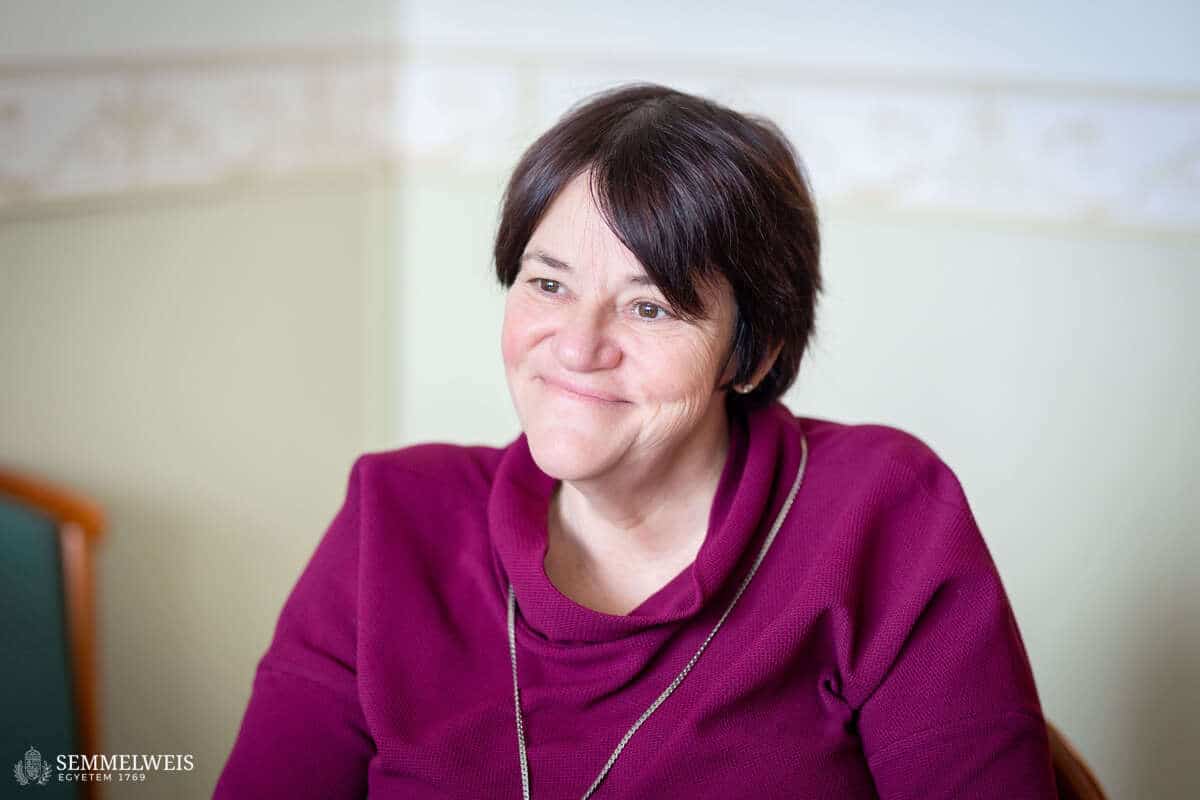
 Dr. Beáta Pethesné Dávid has been a member of the Semmelweis University community for 15 years: She has been working at the Institute of Mental Health (MHI) since 2011, where she has been director since 2013, leader of the Interdisciplinary Social Sciences doctoral program, member of the Senate as well as vice dean of the Faculty of Health and Public Administration since 2015, and dean since January 2026. As a sociologist, her work focuses on researching, measuring, and understanding human relationships. The motto of her dean’s application was taken from a poem by Attila József, “A számokról” (About Numbers), which reminds her that “ones” only gain their true meaning when they are added together or united, just like people. As she recalled, she was able to use this approach on a truly practical level when she was asked to be the head of an institute: She had to stabilize a prosperous institute that suddenly found itself in a difficult situation after its state funding had been cut by half. She said that she would also need to rely on this experience now as dean.
As she pointed out, the Faculty of Health and Public Administration comprises three institutes which operate under very different circumstances. The Health Services Management Training Center (EMK) used to be able to rely on significant grant funding, but this opportunity has now been curtailed. In addition to the existing courses offered by the Institute of Mental Health, a new English-language master’s program in Systemic Psychology is being introduced, which is expected to generate significant revenue for the faculty. The Institute of Digital Health Sciences (DEI) has operated as a kind of ‘underdog’ until now, but they are striving to strengthen its role with new leaders, a redesigned undergraduate training program, and transferable digital skills for the other faculties of the university.
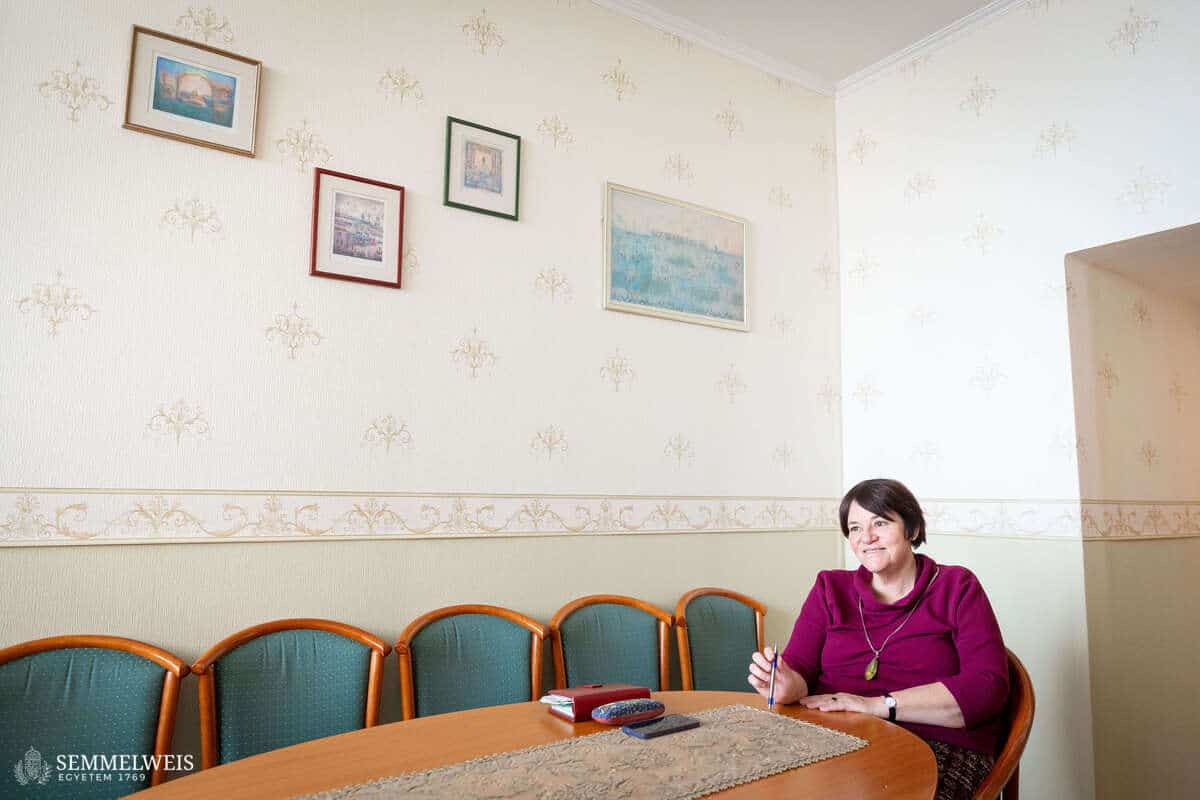 According to the dean, the challenge and task now is what has already proven successful in her previous work as institute director: rethinking and stabilizing the system and consciously seeking synergies. The faculty is less well known to the wider public and even to the Semmelweis community, so building identity and enhancing reputation are among her most important strategic goals. Until now, the three institutes have operated alongside each other rather than actually being connected; the key to the coming years will be joint development and cooperation. This will be greatly aided by one of the biggest changes in the life of the faculty in the near future: the opening of the new campus. EKK is expected to be able to continue its operations on Ferenc Square from September 1, 2026. The faculty’s programs – with the exception of elements linked to BSc training, the laboratories in the Nagyvárad Square Theoretical Block (NET), and certain courses operating on Kútvölgyi Street – will gradually move there, which will significantly strengthen cooperation and the faculty’s identity. The goal is not to have three separate institutional ‘bastions’ with a ‘hedge’ between them, but a single faculty connected by solid walls, the dean pointed out. From 2027, there will be a joint faculty graduation ceremony to show that EKK actually brings together hundreds of students and is thus comparable in size to the larger faculties.
However, further student recruitment is important for all programs: There are six to seven times more applicants than places available for mental health courses, but the social and family sciences areas can still be expanded, and the joint master’s program launched within the international EUniWell framework requires recruitment at the European level. In the case of the Institute of Digital Health Sciences, it is particularly important to make the program attractive to the younger generation.
Within an institutional system focused on medicine and health sciences, the faculty is in a sense an ‘outlier’ as it adopts a social sciences and humanities perspective. However, in her own career, Dr. Beáta Pethesné Dávid has never felt being pushed into the background as a woman or a humanities scholar. Although some years ago, she would have considered it unimaginable to become dean, recent events have confirmed her belief that she is not only capable of carrying through this task but can also bring a new perspective to the life of the faculty.
An important part of her professional identity is that, as a sociologist, she is able to see the social dimensions of healthcare. She has found that in the fields of medicine and natural sciences, it often leads to an Aha! moment when questions of healing are examined not only from a biological, but also from a social, cultural, and mental perspective. She experienced this in her collaboration with Professor Dr. András Falus, former director of the Institute of Genetics, Cell- and Immunobiology, where the goal was to explore the social roots of health literacy and health awareness within the framework of the EDUVITAL Non-profit Health Education Society’s conceptual approach.

An important new development at the faculty related to healing activities is that, with the support of the MOL New Europe Foundation, a new, model Family Therapy Outpatient Department will be established in January 2026 at the Szent Rókus Clinical Block within the framework of the Semmelweis University Outpatient Clinic.
EKK’s research collaborations have already begun in a number of areas: Network analyses conducted with the Városmajor Heart and Vascular Center and support for pharmacy students’ theses all show that the sociological approach is slowly ‘seeping’ into different parts of the university. Dr. Beáta Pethesné Dávid would like to expand the range of joint research projects. For example, a comprehensive survey will soon be launched on the university’s internal communication platform, the MySemmelweis application, to map the use of AI in the Semmelweis community.
“In terms of scientific performance, the faculty was a step behind at the start as publication practices in the social sciences differ from those in medicine,” Dr. Beáta Pethesné Dávid noted. “Nevertheless, we have managed to build a doctoral program that is now outstanding even among sociology doctoral schools: The strict screening used in the admissions process is bearing fruit, with a graduation rate of around 70-80 percent,” the dean explained. The goal remains for the program to meet the academic requirements of Semmelweis University while staying competitive among sociology programs in Hungary.
“The mission is therefore clear – to strengthen the faculty, make it more visible both within and outside the university as a whole, and show how much the social sciences perspective can contribute to healthcare,” Dr. Beáta Pethesné Dávid concluded.
Eszter Keresztes
Translation: Dr. Balázs Csizmadia
Photos by Boglárka Zellei – Semmelweis University