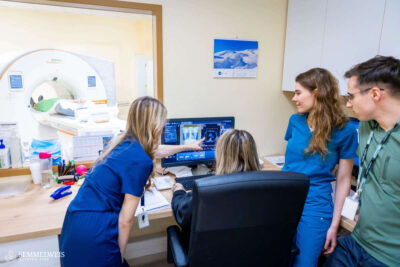
 Dementia research has a long history in Hungarian scientific life. Building on these results, a research group led by Dr. Anita Kamondi, Professor at Semmelweis University’s Department of Neurosurgery and Neurointervention, has developed a solution for early dementia screening using artificial intelligence, in collaboration with several other research centers. The method combines those aspects of traditional mental status examinations and drawing ability tests (fine motor skills) which can be measured instrumentally and processed by a computer.
The project aims to develop a method that can be used to screen the broadest possible segment of the population for the disease and detect it at an early stage, particularly at the primary care level, i.e. in general practitioners’ offices.
 The relevance and necessity of this research is demonstrated by the fact that dementia – a syndrome involving deterioration of thinking, memory functions, and personality – is one of the most significant public health concerns in Hungary and worldwide today. Although there are forms that appear at a relatively early age, it typically affects the elderly. According to public health statistics, the incidence of dementia among people over 60 is approximately 7 percent in Hungary. Given that the condition indirectly affects family members too, it could impact up to one million people in Hungarian society. Based on all of the above, the project was included in the list of priority AI developments supported by the Ministry of Interior.

The primary goal of the study is to clinically validate an AI-based motion analysis system intended for use on a tablet, with the participation of 3,000 test subjects. The secondary objectives are to determine the sensitivity and specificity of the method as a pilot study, and to lay the groundwork for further biomarker-based studies.
Healthcare institutions participating in the research project:
Semmelweis University, University of Pécs Clinical Center, Nyírő Gyula National Institute of Psychiatry and Addiction, Szent János Hospital and North Buda Unified Hospitals, Bács-Kiskun County Teaching Hospital, Budapest Péterfy Sándor Street Hospital, Jahn Ferenc South-Pest Hospital, Budapest Károlyi Sándor Hospital, Kistarcsa Flór Ferenc Hospital, Vasútegészségügyi Public Benefit Company.
Department of Neurosurgery and Neurointervention; National Directorate General for Hospitals
Translation: Judit Dőtsch
Photos by Bálint Barta – Semmelweis University