Maintaining the progress achieved in tobacco control requires more than simply maintaining existing measures: regulation must evolve in response to changes in consumption patterns, emerging tobacco and nicotine products, and market developments.
This was also highlighted by Dr. Tamás Joó, Deputy Director of the Health Services Management Training Center at the Faculty of Health and Public Services, Semmelweis University, at the AIPM conference, The Nation’s Lungs – How Can Healthcare Breathe New Life?. Researchers from the Data Science in Health and Artificial Intelligence Knowledge Center also presented two posters demonstrating how data science and AI methods can be applied to tobacco control and the evaluation of tobacco regulation.
The Association of Innovative Pharmaceutical Manufacturers (AIPM) held its conference on 10 September 2026, focusing on the burden of respiratory diseases in Hungary, as well as opportunities for prevention, early diagnosis, patient pathways, and innovation. Associate Professor Dr Tamás Joó first participated in the panel discussion entitled How Can Mortality from Lung Diseases Be Reduced?” followed by a presentation entitled The Long-term Public Health Impacts of Tobacco Retail Regulation in an International Context – What Have We Learned Over a Decade?. The presentation was co-authored by researchers from the Data Science in Health and Artificial Intelligence Knowledge Center of the Faculty of Health and Public Services, Semmelweis University.
The Knowledge Center was also represented at the conference by two additional scientific posters.
Lessons from previous achievements must inform the next phase
The roundtable discussion, moderated by Konrád Keresztes, featured Dr. László Buga, State Secretary; Prof. Dr Lilla Tamási, Deputy Director of the Department of Pulmonology at Semmelweis University, Dr. Anna Kerpel-Fronius, Deputy Director-General and Director responsible for diagnostics at the National Korányi Institute of Pulmonology and Tibor Demjén, tobacco control expert.

The discussion also addressed the tobacco control measures implemented over the past 15 years and their outcomes. Dr. Tamás Joó emphasized that international experience indicates that significant opportunities for implementing effective tobacco control measures often arise at political turning points, following a change of government or at the beginning of a new governmental term. At such times, decision-makers may have the political momentum and policy space required to introduce several mutually reinforcing measures within a relatively short period.
The major measures implemented in Hungary between 2010 and 2012 were likewise supported by professional preparation, a strong governmental commitment to policy action, and health-sector leadership that consistently advocated for their implementation.
Tobacco control, therefore, often presents genuine “now or never” windows of opportunity: if a government does not act early in its term, it may subsequently become considerably more difficult to adopt measures of comparable scope. One reason is that scientific evidence indicates that the tobacco industry simultaneously uses formal points of access and non-public channels of influence in policymaking processes, which may become increasingly extensive over time (1, 2, 3). Another factor is that as elections approach, policymakers tend to become more cautious about measures that affect the everyday habits of millions of potential voters.
What have we learned from more than a decade of tobacco regulation?
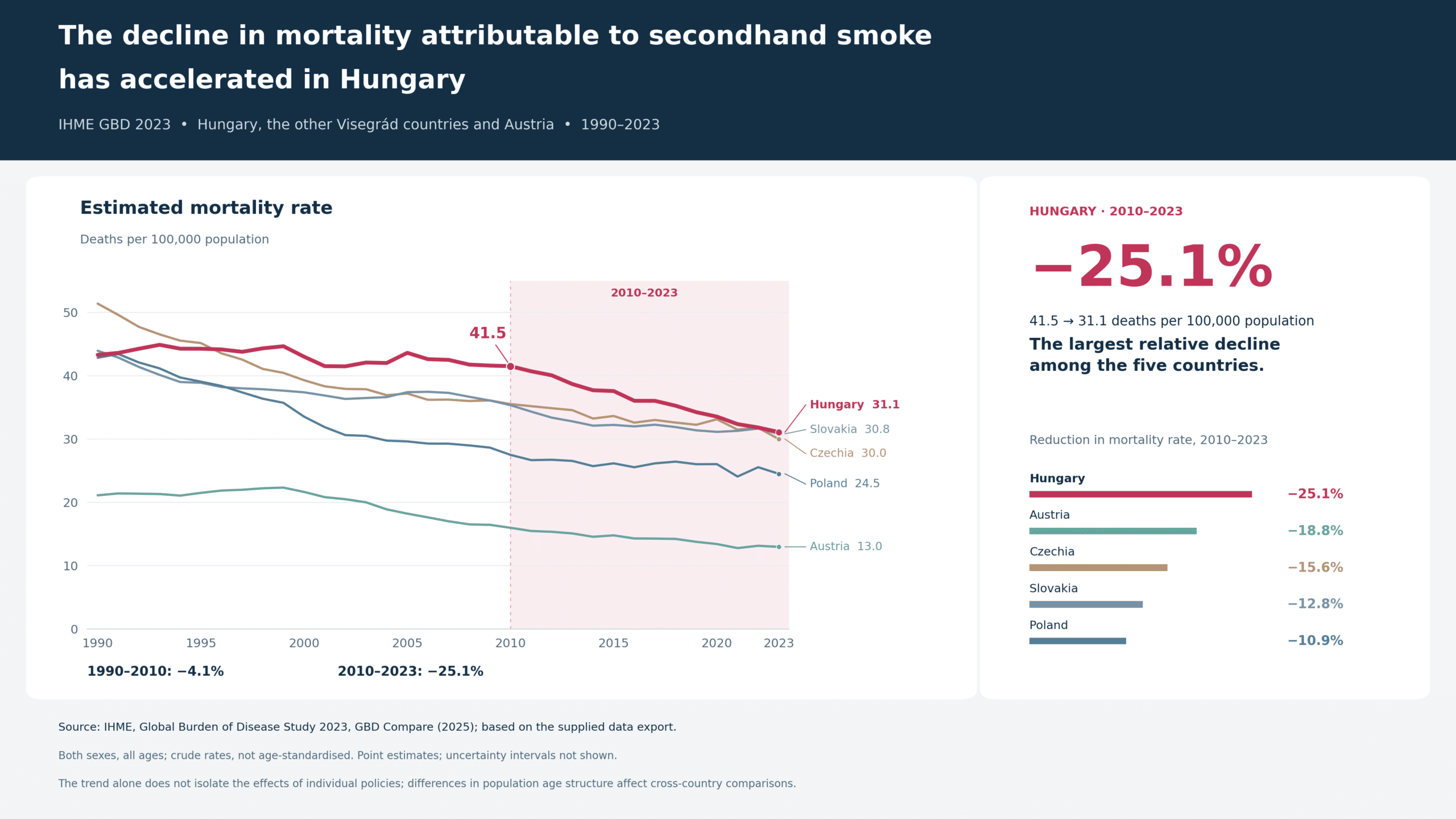
In his presentation, Dr. Tamás Joó assessed the long-term effects and lessons from the tobacco control measures introduced in Hungary between 2010 and 2012, during the tenure of Dr. Miklós Szócska as State Secretary for Health, and placed these developments in an international context. The analysis covered, among other areas, strengthened protection of non-smokers, increases in excise duties, the introduction of pictorial health warnings, and the restructuring of the tobacco retail system. As a result of the retail reform, the number of outlets selling tobacco products decreased by approximately 85%. One of the most important outcomes in the period following the comprehensive package of measures was a substantial reduction in mortality attributable to second-hand smoke in Hungary.
According to estimates from the IHME Global Burden of Disease Study 2023, between 2010 and 2023 the mortality rate attributable to second-hand smoke in Hungary declined from 41.5 to 31.1 per 100,000 population, representing a 25.1% reduction. This was the largest proportional decline among the countries examined—Hungary, Austria, and the other V4 countries—while the pace of improvement in Hungary accelerated markedly compared with the preceding two decades before 2010.
A central message of the presentation, however, was that the early gains achieved through regulation cannot be regarded as self-sustaining. Consumption patterns, the structure of the tobacco and nicotine market, and the range of products available are constantly evolving. Measures that were effective in the past therefore require regular review and, where necessary, policy adjustment.

Among the key priorities for the coming period, the presentation highlighted strengthening smoking cessation support; more systematic monitoring of the tobacco and nicotine product market; developing taxation, access, and advertising policies that respond to emerging patterns of consumption; and more consistent enforcement of professional and ethical standards governing public statements by healthcare professionals.
Particular importance should be attached to the transparent management of potential conflicts of interest, as well as stronger action by professional societies against industry influence, the concealment of conflicts of interest, and health communication that lacks an adequate scientific evidence base.
Artificial intelligence and data science in tobacco control
The two posters presented by the Knowledge Center provided concrete examples of how data science and artificial intelligence can be applied directly to investigating a major public health challenge, such as tobacco control.
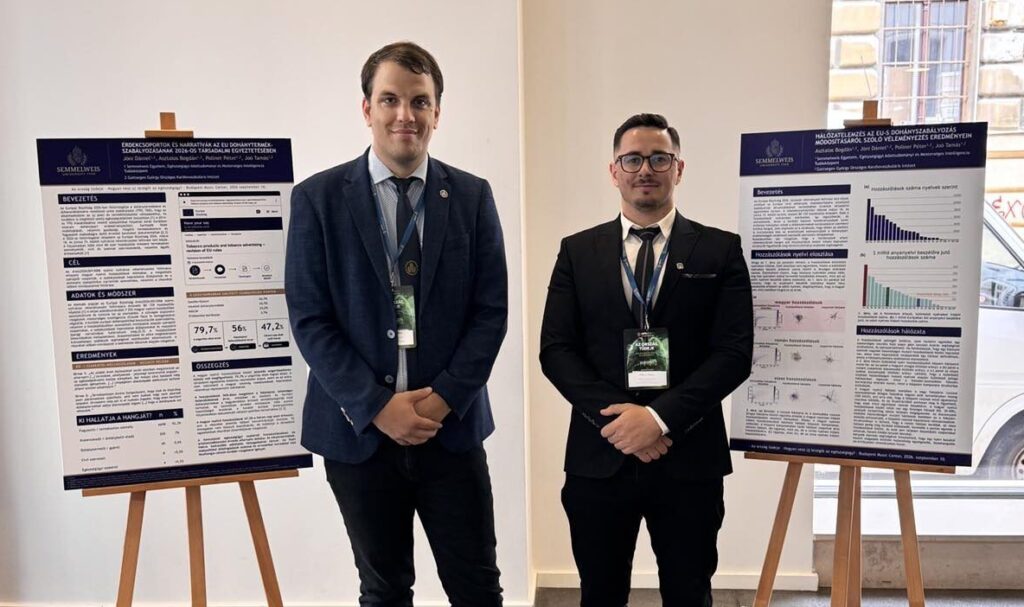
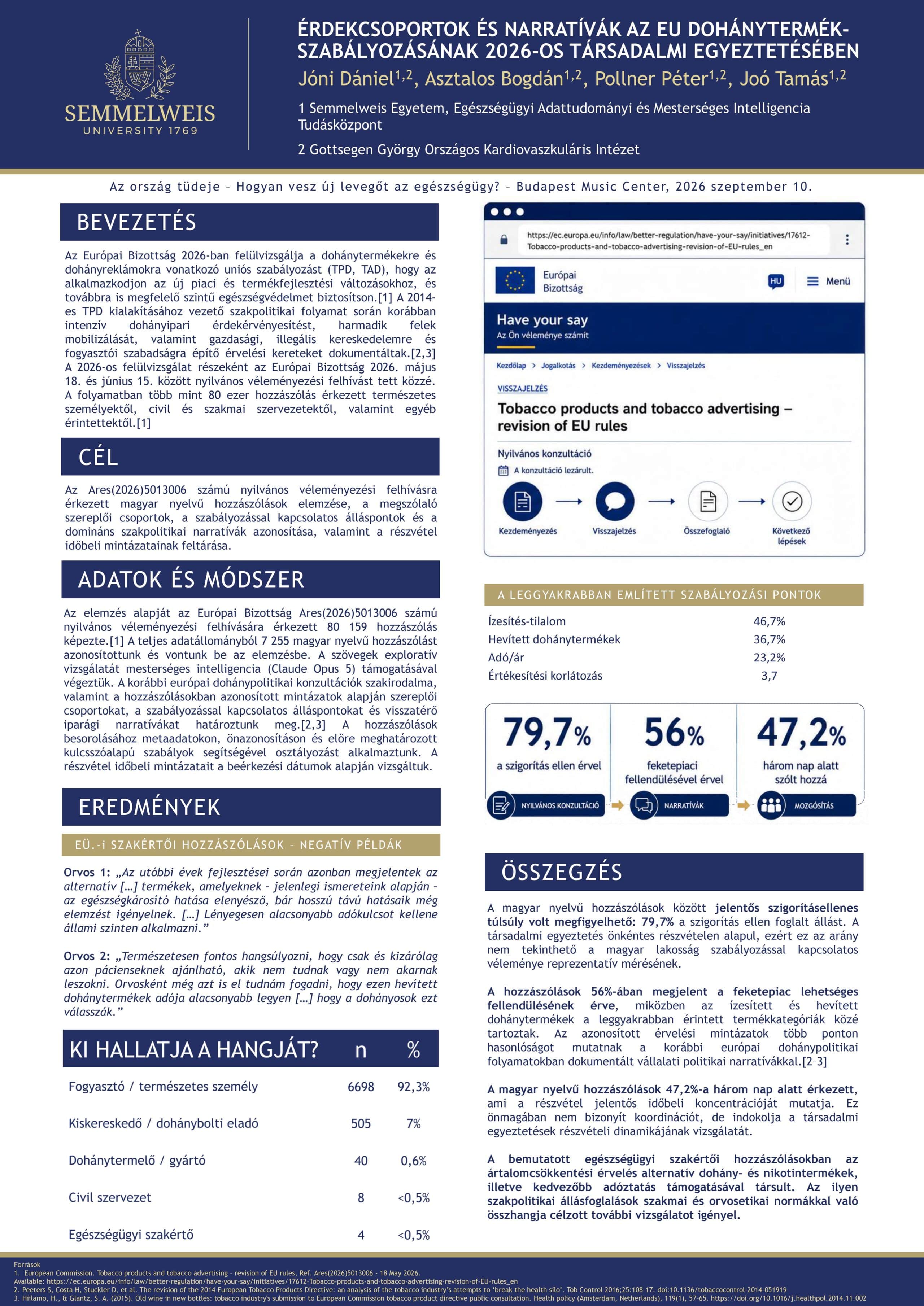
In their studies, Dániel A. Jóni and Bogdán Asztalos, together with Dr. Péter Pollner and Dr. Tamás Joó, analyzed Hungarian-language submissions to the public consultation conducted as part of the European Commission’s review of tobacco product and tobacco advertising regulation.
One of the studies analyzed participant groups, argumentation patterns, and the temporal distribution of submissions. Of the more than 80,000 submissions received, the researchers analyzed 7,255 Hungarian-language contributions. Of these, 79.7% opposed stricter regulation, while 47.2% of the Hungarian submissions were received during just three days of the one-month consultation period.
The analysis also paid particular attention to submissions in which contributors identified themselves as healthcare professionals or experts. In some cases, the researchers identified elements of argumentation that resembled industry communication, while the scientific basis of certain claims was not clear.
An important conclusion of the study was therefore the specific communication responsibility of healthcare experts. Professional authority lends considerable weight to public statements concerning tobacco and nicotine products. Evidence-based communication, transparent disclosure and management of potential conflicts of interest, and a clear distinction between claims supported by robust scientific evidence and issues where uncertainty remains are therefore essential requirements.
Patterns in thousands of submissions analysed using machine learning
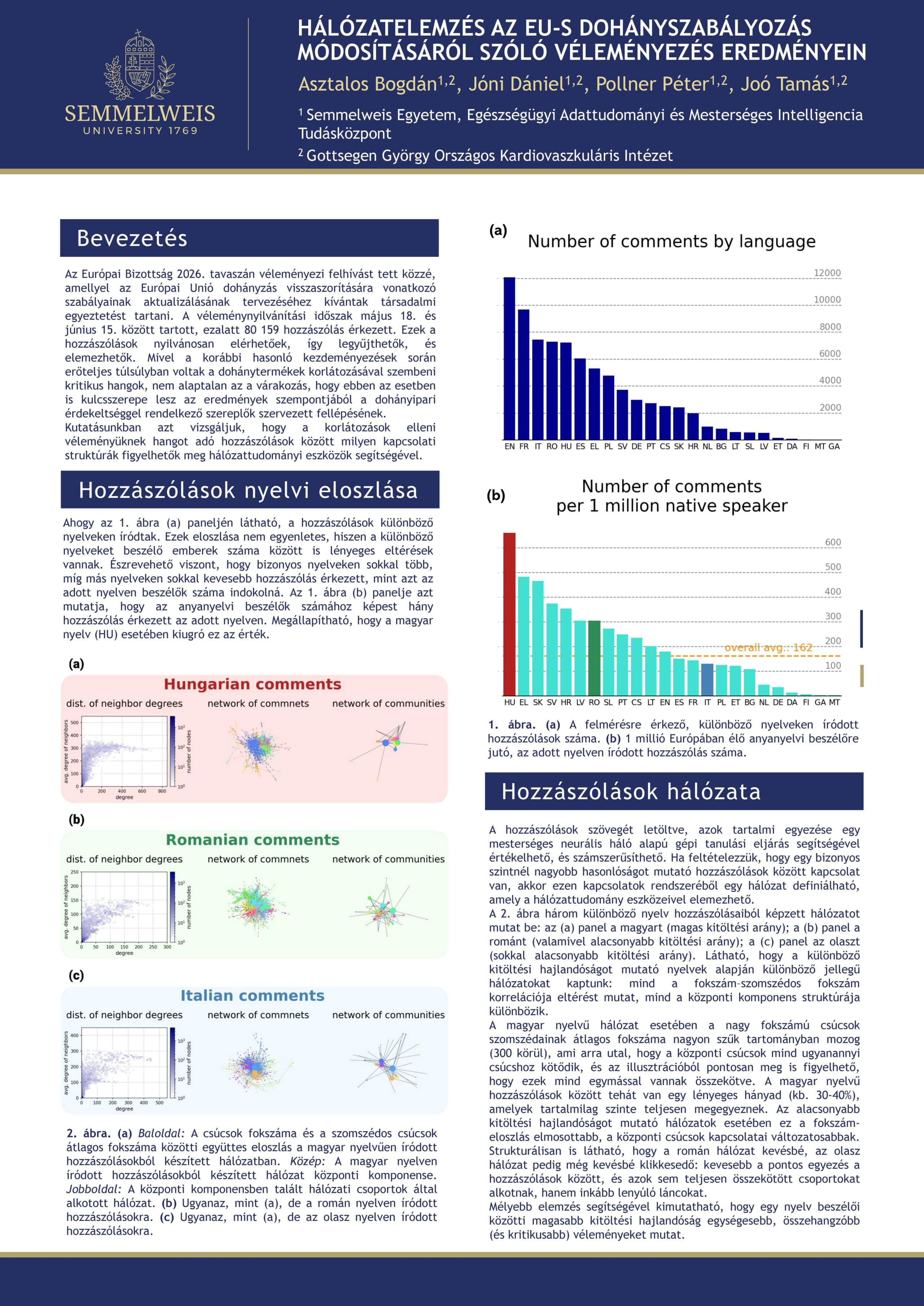
The second poster applied machine-learning-assisted text and network analysis methods to the same set of thousands of Hungarian-language submissions.
Relative to the number of native Hungarian speakers, the analysis identified an exceptionally high level of participation from Hungary. The researchers also identified very strong content similarity in approximately 30–40% of the Hungarian-language texts, while a substantial proportion of the submissions was also strongly concentrated within a limited period.
These findings warrant further investigation into the processes underlying the observed patterns of participation and textual similarity. The researchers nevertheless emphasized that content similarity and temporal concentration alone do not demonstrate organized or coordinated activity, nor do they establish a common origin.
The two studies illustrate how data science and artificial intelligence can complement traditional analytical approaches to large-scale policy consultations, providing tools that can identify key themes, patterns of argumentation, relationships, and unusual participation phenomena across tens of thousands of textual submissions. In the future, such approaches may also become important tools for evidence-based public health policymaking and the evaluation of regulatory processes.
References
- Watts, C., Jones, M., Lindorff, K., & Freeman, B. (2023). How tobacco companies use the revolving door between government and industry to influence policymaking: an Australian case study. Public Health Research & Practice. https://doi.org/10.17061/phrp33122305
- Van Der Eijk, Y., & Tan, G. (2021). Tobacco industry’s ‘behind the scenes’ tactics in Singapore. Tobacco Control, 32, 280–286. https://doi.org/10.1136/tobaccocontrol-2021-056775
- Assunta, M. (2025). Global Tobacco Industry Interference Index 2025. Global Center for Good Governance in Tobacco Control (GGTC), Bangkok, Thailand.