History of the Building
Located at 67 Villányi út in Budapest’s 11th district (Újbuda), this site holds historic significance for conductive pedagogy, as it served as the original home of the institution founded by Dr. András Pető.
The official story of the building began on February 1, 1950, when the Hungarian State established the National Motor Therapy Institute (Országos Mozgásterápiai Intézet) under Pető’s direction. Originally operating in a modest ground-floor building, the institute launched its nationwide conductor-guided educational and developmental work here. As the number of resident and outpatient children and adults rapidly grew—particularly following the polio epidemics of the 1950s—the original facility required multiple expansions over the years to include kitchens, laundries, libraries, and expanded therapy spaces.
In the 1990s, with support from international partners (including a 5-million-pound contribution from the British government offered following Princess Diana’s visit in 1990), the site underwent substantial modernization and accessibility enhancements. Today, the complex forms an integral part of the infrastructure of Semmelweis University’s Pető András Faculty.
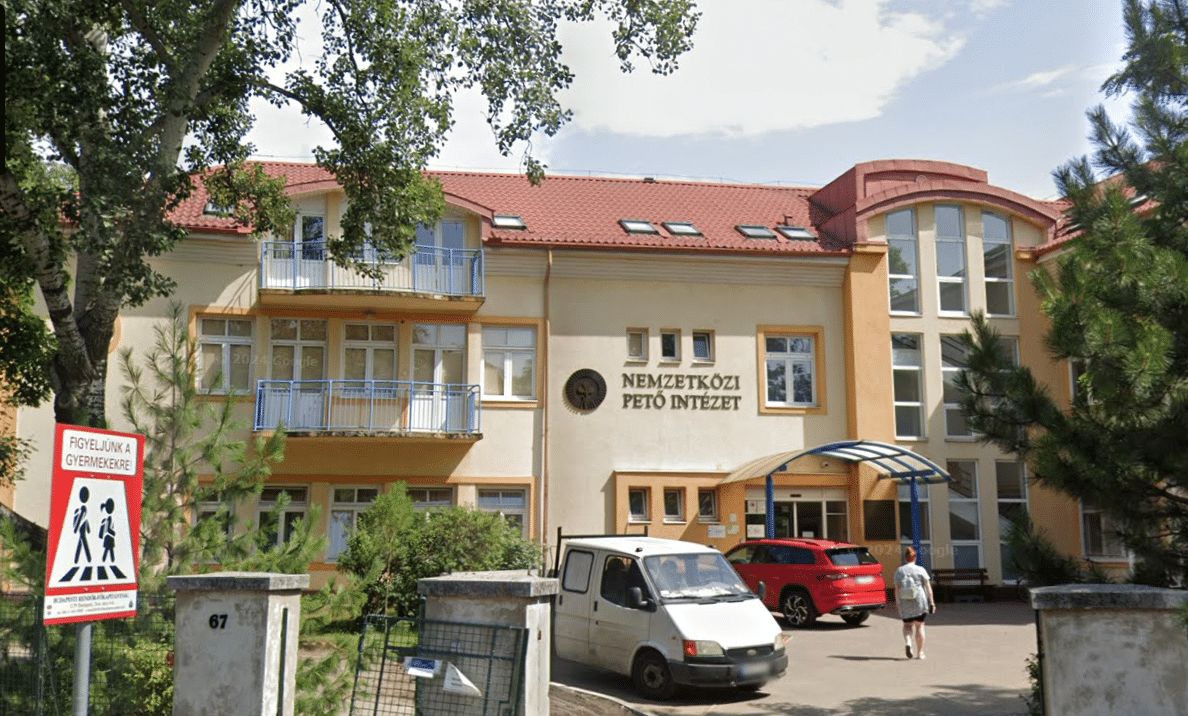
The Institution Today
Operating as a dedicated campus of Semmelweis University’s Pető András Faculty, the Villányi út complex functions primarily as the public education, specialized training, and residential hub of the conductive pedagogy network. While administrative and higher education degree programs are centered at Kútvölgyi út, the Villányi út site provides the essential environment where conductor students complete an extensive portion of their practical training alongside practicing educators and specialists.
Services Currently Available
The Villányi út facility houses specialized educational, developmental, and residential services tailored for children and youth with central nervous system movement disorders:
The complex is home to the Conductive Pedagogy Primary School and the Conductive Pedagogy Vocational School, which follow the national curriculum adapted through conductive pedagogical principles for both lower and upper primary grades as well as vocational education. It also houses the Pető Dormitory, providing full residential care, boarding, and daily living support for students attending the practice schools from outside Budapest.
Furthermore, the site provides support services including speech therapy, school psychology, learning support, and pedagogical assistance.