(Katalni Dezső, MD)
Research area:
The main research area of our working group is the investigation of various forms of liver regeneration in rat models and the interpretation of the obtained results in the context of human liver diseases.
Main results of our group:
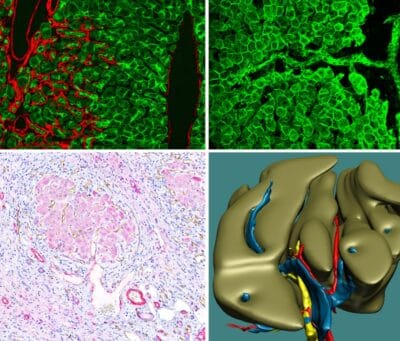
We used fluorescent immunohistochemistry to study liver regeneration and characterize the small bile ductules that serve as a source of somatic stem cells in healthy human and rat livers. We studied in detail the development of the lobular structure of the rat liver during liver regeneration from hepatocytes and stem cells. Our results showed that during regeneration either from hepatocytes or stem cells, liver mass was restored exclusively through the enlargement of the preexisting lobules. In our current experiments we are investigating whether altered liver structure resulting from regeneration has any functional consequences. Preliminary results suggest that the regenerated livers may be more susceptible to damage.
We have also successfully distinguished two forms of regeneration in human liver samples after massive hepatic necrosis. Restoration of liver mass is achieved either by AFP-positive acinary- arranged hepatocytes or by regenerative foci derived from stem cells. Regenerative foci are formed around the terminal branches of the portal vein, highlighting the unquestionable role of the portal vein in coordinating the regenerative process.
Liver cirrhosis can also be understood as a prolonged regenerative process. We hypothesise that disrupting the connection between bile ductules — which behave like stem cells — and the parenchyma may lead to ‘irregular’ regeneration. In clinical practice, this results in a condition known as advanced or irreversible phase of liver cirrhosis.
Publications:
Dezső K, Paku S, Juhász MM, Kóbori L, Nagy P. Evolutionary view of liver pathology. Evolutionary applications 2024:17:e70059
Dezső K, Paku S, Kóbori L, Thorgeirsson SS, Nagy P What makes cirrhosis irreversible?- Consideration on structural changes. Frontiers in Medicine 9,876293, 2022
Dezső K, Nagy P, Paku S Human liver regeneration following massive hepatic necrosis: Two distinct patterns. Journal Gastroenterol hepatol 35:124-134, 2019
Dezső K, Rókusz A, Bugyik E, Szücs A, Szuák A, Dorogi B, Kiss M, Nemeskéri Á, Nagy P, Paku S. Human liver regeneration in advanced cirrhosis is organized by the portal tree. J Hepatol. 2017 66:778-786]
Papp V, Rókusz A, Dezső K, Bugyik E, Szabó V, Pávai Z, Paku S, Nagy P. Expansion of hepatic stem cell compartment boosts liver regeneration. Stem Cells Dev, 23:56-65, 2014.
Dezső K, Papp V, Bugyik E, Hegyesi H, Sáfrány G, Bödör C, Nagy P, Paku S. Structural analysis of oval cell mediated liver regeneration in rats. Hepatology. 56:1457-67, 2012.
The research group:
Péter Nagy, professor
Sándor Paku, senior research fellow
Katalin Dezső, senior lecturer
Lóránd Váncza, resident
Mária Manuela Juhász, PhD student
Máté Manó Hunyadi, scientific student worker
Collaborators:
Ezio Laconi – Università degli studi di Cagliari, Sardinia
Melinda Rezeli – Lund University
Julio Diaz-Perez – Virginia Commonwealth University
Balázs Döme – Medical University of Vienna
Emilio Casanova – Medical University of Vienna