When patients and healthcare providers don’t share a common language, essential medical information may be lost or misunderstood, affecting both patient safety, treatment outcomes and patient satisfaction. A new research project aims to identify transferable good practices for language assistance within Europe to promote safer, more equitable, and higher-quality care.
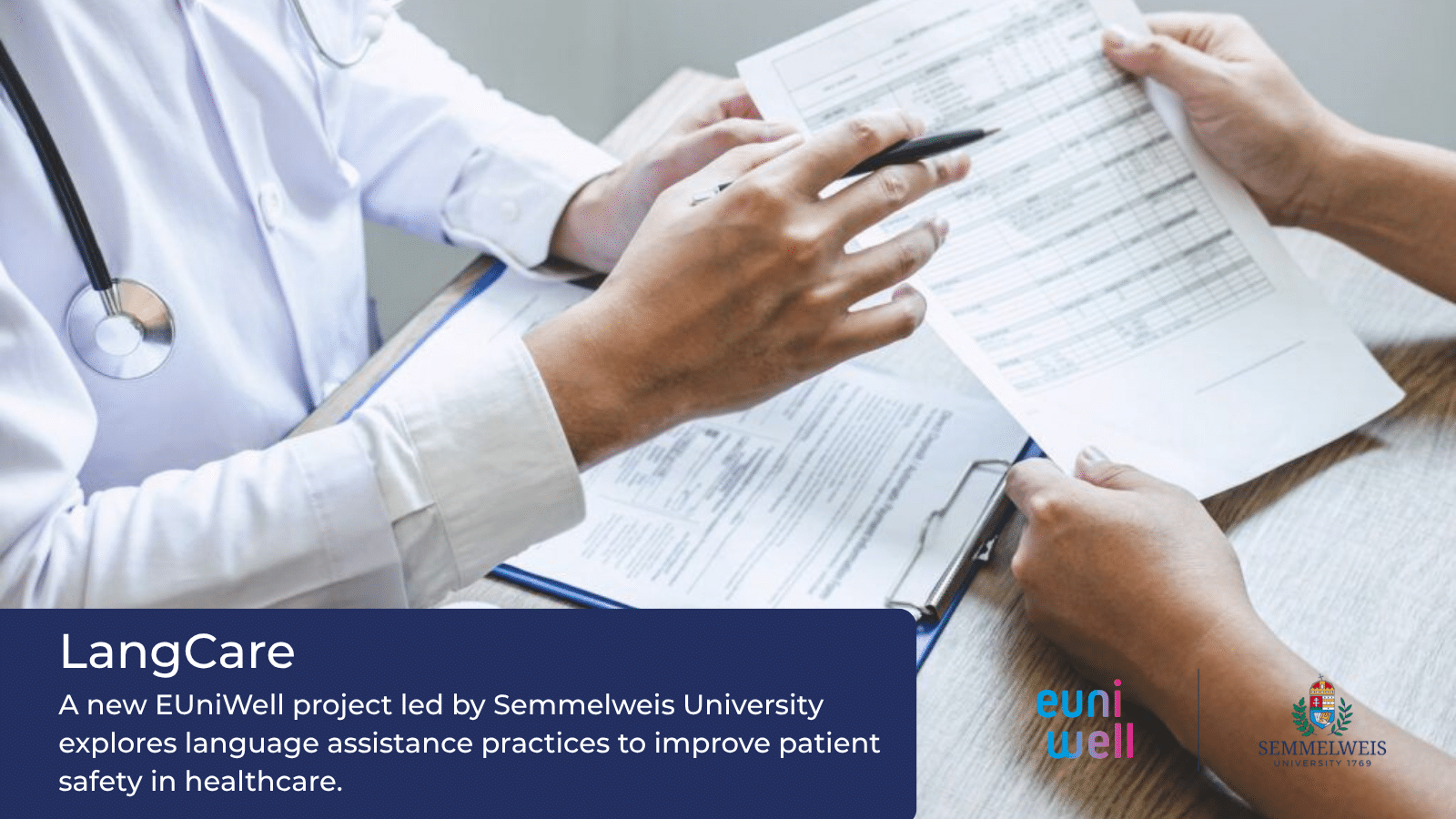
Accessing healthcare services while not being able to speak the local language often requires additional support, such as interpreting or translating medical documents. While these measures help bridge linguistic barriers, their availability and use vary significantly across Europe. To strengthen equity, access and patient safety, a new research project compares language assistance systems across five European countries to identify practical solutions that can be adapted in different healthcare settings. The project called LangCare (Multilingual Patient Safety: Comparative Study of Language Assistance in Healthcare) is coordinated by Ágnes Horváth, Assistant Professor at Semmelweis University.
The project aims to improve well-being, protect linguistic diversity and foster intercultural communication, which fully aligns with the mission of EUniWell, the European University for Well-Being. Consequently, after it was submitted to its 9th Seed Funding Call, LangCare was among the 10 selected projects for funding out of the record number of 70 submissions.
Bringing together 12 universities, including Semmelweis University, EUniWell is a hub for innovative interdisciplinary collaboration, research, educational leadership and civic engagement – all focused on improving social, mental and physical well-being.
While the project is led by academic staff and students from Semmelweis University, it is a shared effort with five other EUniWell partner Universities: the National Institute for Oriental Languages and Civilizations (INALCO) and the Universities of Birmingham, Florence, Murcia and Santiago de Compostela, as well as the Associated Partners Universidad de Granada, Universitad de La Laguna, Universidad Autónoma de Barcelona and Universidad de Alicante.
Looking for an opportunity to turn your innovative idea into reality?
Apply now to EUniWell’s 10th Seed Funding Call and fund your project with up to EUR 25,000! Proposals must involve a collaboration between at least four EUniWell member universities and focus on improving health, education, society, institutional transformation, environment, social and gender equality, and cultural inclusion.
The deadline for applications is 17 May 2026. Find the application form and more information on the dedicated EUniWell website.
Semmelweis University’s involvement in the EUniWell program is supported by the National Research, Development and Innovation Fund (NKFIH).