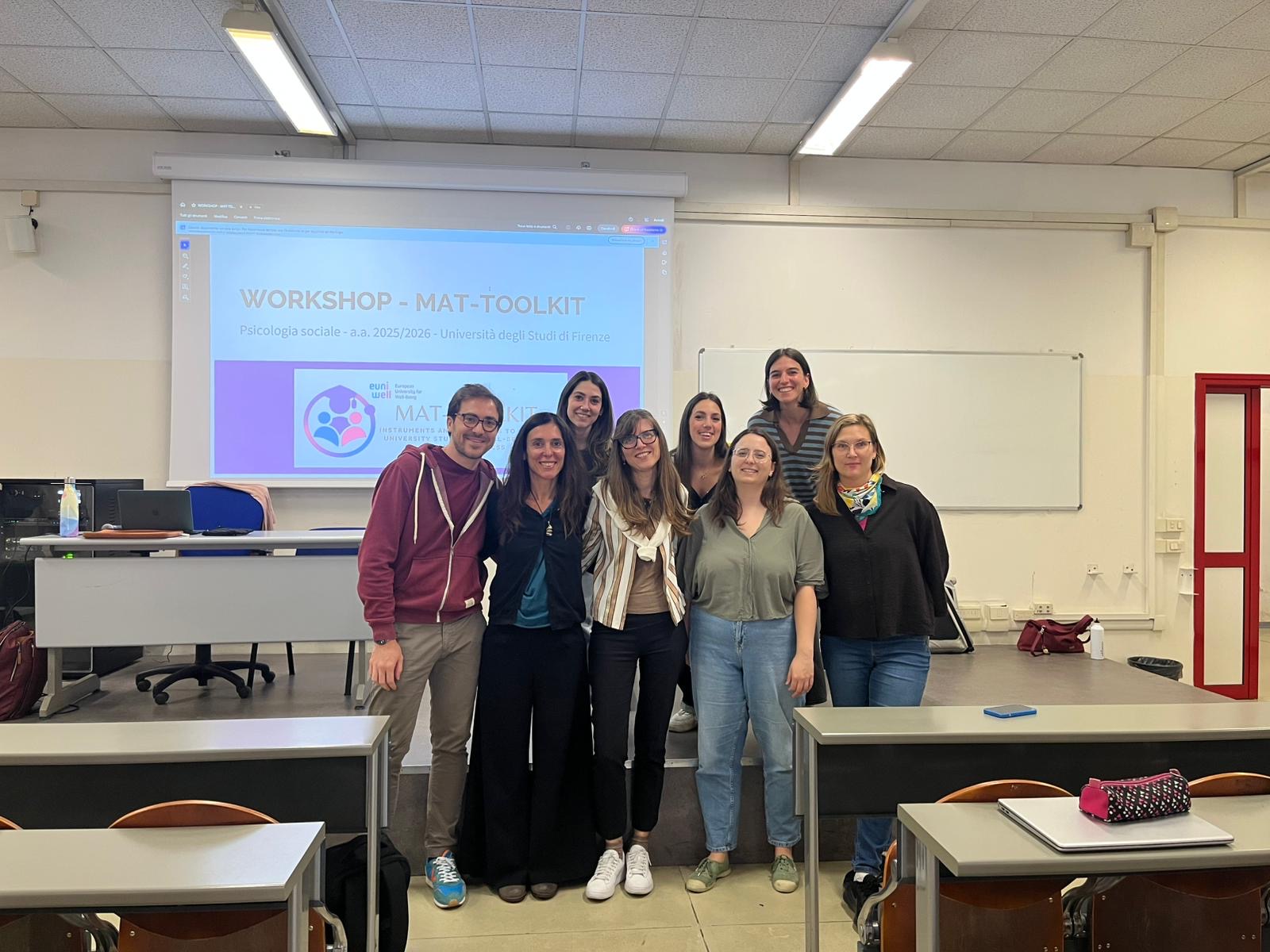
Dr. Zsuzsanna Papp, Assistant Professor at Semmelweis University’s Institute of Mental Health, participated in a workshop hosted by the University of Florence between 11–13 May, which served as one of the final events of the MAT-Toolkit project funded under the 7th EUniWell Seed Funding Call.
The current project builds directly on a previous successful EUniWell collaboration. During the initial research phase, mixed-methods data collection and intervention activities were carried out at three partner institutions: the University of Florence, Semmelweis University, and the University of Birmingham. The research focused on university students’ well-being and the concept of mattering—an innovative and emerging construct in higher education research that refers to the feeling of being valued and important within a community.
In addition to extending the research, the main objective of the current phase was to translate the findings into practice through the development of a toolkit designed to support students’ sense of mattering and overall well-being. The toolkit was developed primarily at Semmelweis University through the close collaboration of colleagues from the Institute of Mental Health and the Institute of Behavioural Sciences.
The primary aim of the visit to Florence was to present the toolkit developed at Semmelweis University to an international audience and to validate its practical application. As part of the closing event, the toolkit was tested with a larger group of Italian students.
The toolkit has been designed to be adaptable for students, educators, and university staff alike, and includes:
- Self-guided exercises and reflective activities;
- Educational and background materials in both written and video formats;
- Teaching and pedagogical recommendations;
- A collection of personal stories illustrating what mattering means from students’ perspectives and how it contributes to their everyday well-being.
During the workshop in Florence, the toolkit was presented to a larger student group, and participants were invited to provide detailed feedback on the relevance and usability of its various elements. The responses were highly positive, and the feedback gathered during the event will be incorporated into the final version of the toolkit, which will soon be made available to EUniWell partner universities.
 Semmelweis University’s involvement in the EUniWell program is supported by the National Research, Development and Innovation Fund (NKFIH).