What if the key to well-being lies not in a new method, but in a centuries-old practice? Semmelweis University participates in a research project that explores how walking pilgrimage can become a form of mental, physical, social and spiritual well-being – and even a kind of therapy.
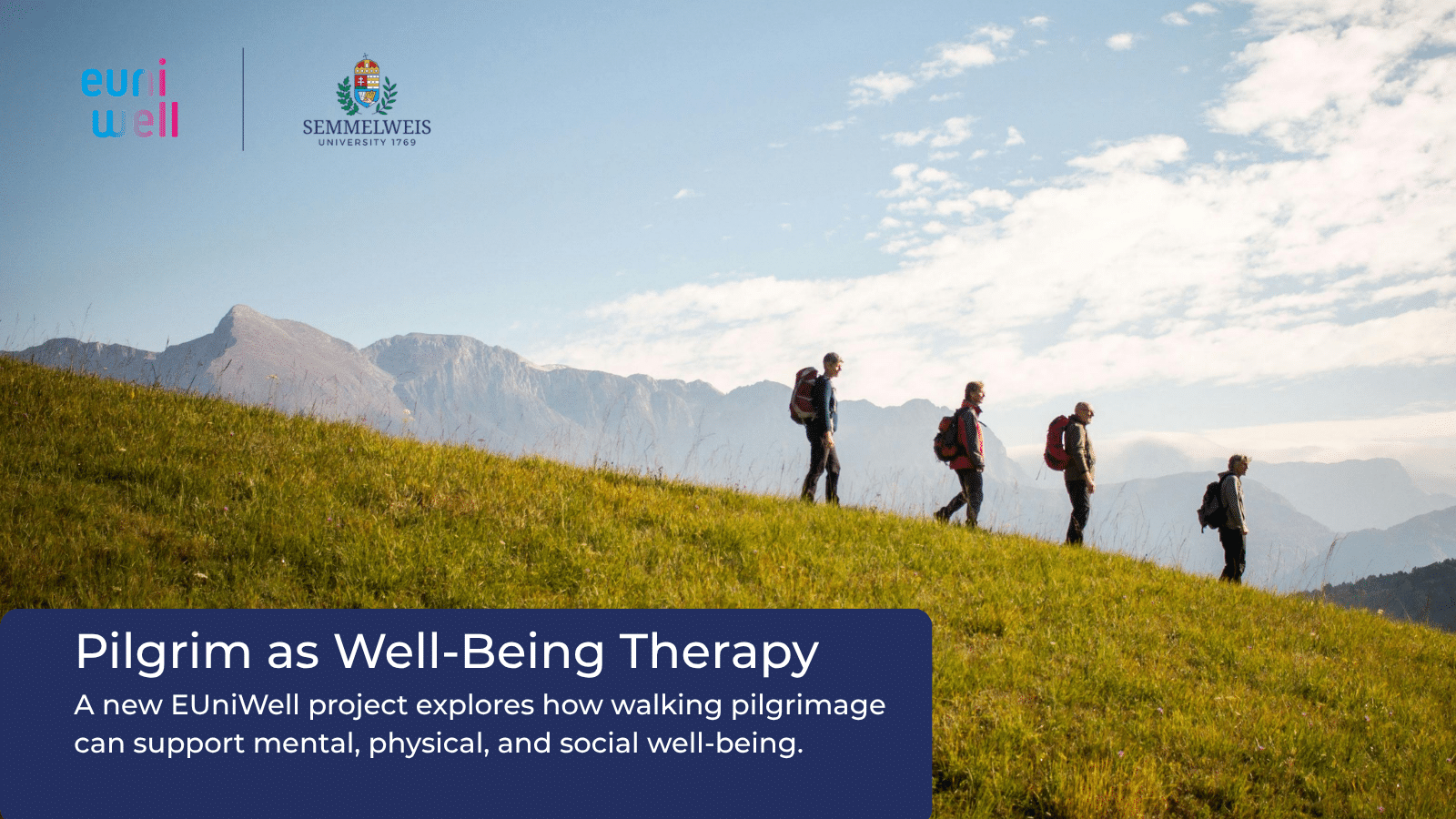
The challenges of modern life – such as stress, anxiety, and the lack of social connections – are creating a growing demand for alternative solutions that support both physical and mental balance. Walking pilgrimage offers a unique combination of physical activity, connection with nature, opportunities for social interaction, and a deeper, spiritual quest for meaning in life thus contributing to well-being in a complex way.
The Pilgrim-Aphy-Tour project – awardee of the 8th Call of the EUniWell Alliance’s Seed Funding Program – builds on this recognition. The project does not only examine the question on a theoretical level – but researchers are also literally set out on the journey. They collect data along four iconic European pilgrimage routes: the Camino de Santiago, the Via Francigena, the Camino Podolico and the Way of Mary. From Semmelweis University, Pilgrim-Aphy-Tour is coordinated by Zsuzsanna Papp, Assistant Professor at the Institute of Mental Health.
Through a complex, online questionnaire researchers ask pilgrims about their motivations, how they feel during the journey, and what changes their experience. At the same time, local stakeholders -such as tourism professionals or healthcare providers – are also interviewed to gain a comprehensive understanding of the effects of pilgrimage. During the shared fieldwork, researchers not only collect data but also examine – through their own experiences – how walking, nature, and the rhythm of pilgrimage affect individuals.
This dual approach – combining scientific analysis with personal experience – makes the research particularly valuable and allows for a comprehensive understanding of pilgrimage.
Bringing together 12 universities, EUniWell serves as a platform for innovative interdisciplinary collaboration, research excellence, educational leadership and civic engagement, all aimed at enhancing social, mental, and physical well-being. Pilgrim-Aphy-Tour has been selected for funding as a joint research effort of 4 partner universities from the alliance: the University of Santiago de Compostela, the University of Florence, the Taras Shevchenko National University of Kyiv and Semmelweis University.
The results of Pilgrim-Aphy-Tour are expected to contribute to a deeper understanding of the relationship between pilgrimage and well-being, while also providing practical recommendations for healthcareprofessionals, policymakers, and tourism stakeholders. In the long term, the research may promote a perspective that sees pilgrimage as a meaningful tool for supporting mental health.
Looking for an opportunity to turn your innovative idea into reality?
Apply now to EUniWell’s 10th Seed Funding Call and fund your project with up to EUR 25,000! Proposals must involve a collaboration between at least four EUniWell member universities and focus on improving health, education, society, institutional transformation, environment, social and gender equality, and cultural inclusion.
The deadline for applications is 17 May!
Find the application form and more information on the dedicated EUniWell website.
 Semmelweis University’s involvement in the EUniWell program is supported by the National Research, Development and Innovation Fund (NKFIH).