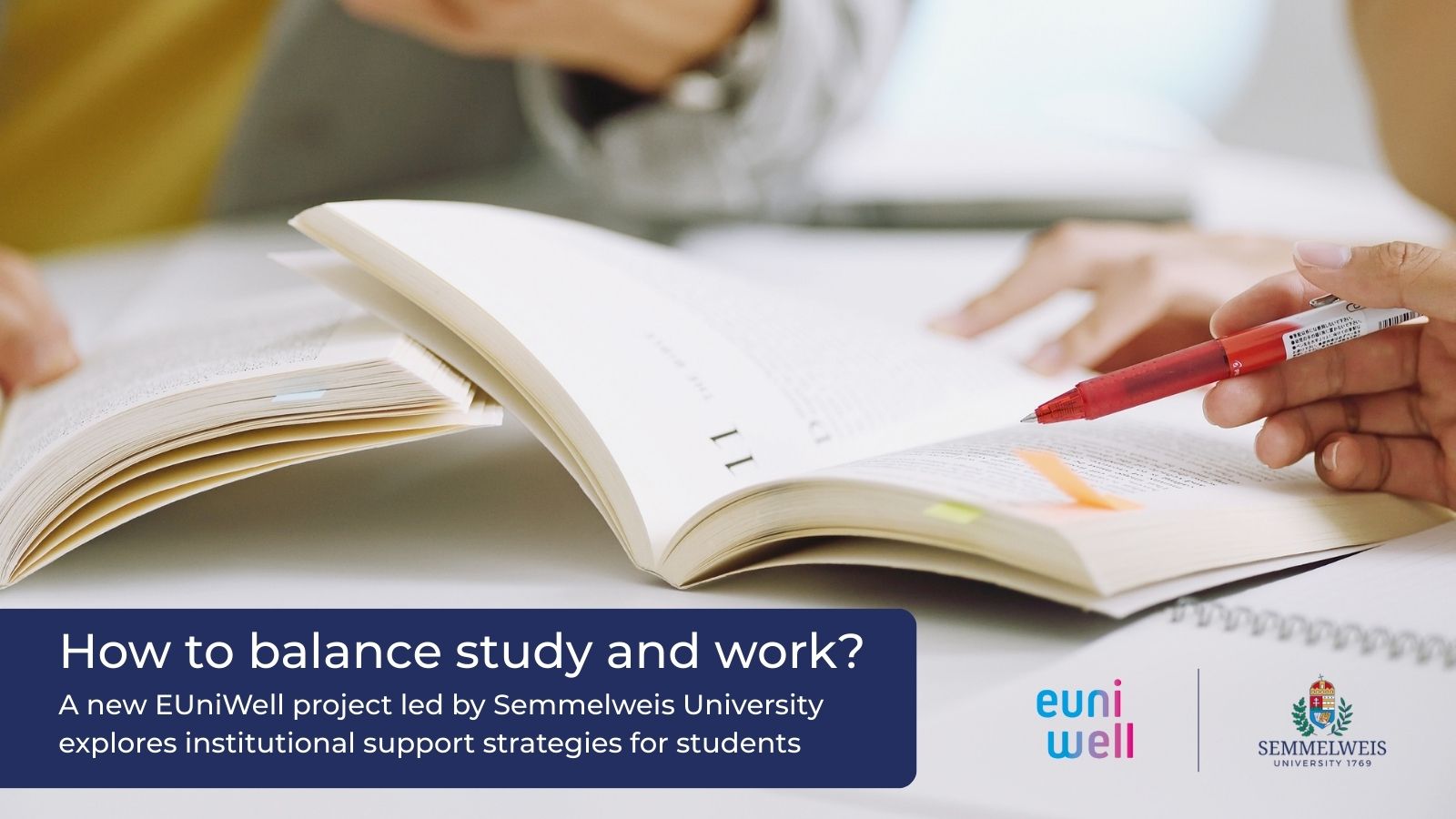
According to a 2021 study, nearly half of university students work alongside their studies in Europe –a balancing act that can be difficult to sustain in the long term. With a growing number of students affected across Europe, questions about well-being, academic performance, equity, and institutional responsibility have become increasingly pressing. Despite the scale of the phenomenon, systematic, cross-country evidence on how universities support working students remains limited.
A new research project led by Semmelweis University seeks to address this gap. The project will explore student employment trends across Europe, identify key challenges, and examine positive institutional practices that help students balance work and study, ultimately supporting the development of policies that promote student well-being and academic success. The project called Study-WorkWELL (Balancing Study and Work: Understanding Student Employment and Well-Being Across Europe) is coordinated by the András Pető Faculty of Semmelweis University, with coordination led by Dr. Márk Pulay and Dr. Ibolya Túri.
The project is a collaboration between academic staff and students from Semmelweis University and four other European universities ( University of Florence, University of Konstanz, Linnaeus University, and the University of Murcia). The proposal was submitted to the 9th Seed Funding Call of EUniWell, the European University for Well-Being, and was selected from a highly competitive pool of applications, underscoring its relevance and timeliness.
EUniWell unites 12 European universities with the shared mission of improving social, mental, and physical well-being through interdisciplinary research, education, and civic engagement. The Study-WorkWELL project is closely aligned with this mission and will run over a period of 12 months.
The findings of the Study-WorkWELL project are expected to serve as a foundation for future EUniWell initiatives, contributing to data-driven improvements in institutional policies and fostering more student-centered approaches to higher education across Europe.
Looking for an opportunity to turn your innovative idea into reality?
Apply now to EUniWell’s 10th Seed Funding Call and fund your project with up to EUR 25,000! Proposals must involve a collaboration between at least four EUniWell member universities and focus on improving health, education, society, institutional transformation, environment, social and gender equality, and cultural inclusion.
The deadline for applications is 17 May 2026. Find the application form and more information on the dedicated EUniWell website.
 Semmelweis University’s involvement in the EUniWell project is supported by the National Research, Development and Innovation Fund (NKFIH).