History of the Centre for Translational Medicine
The history of translational medicine – from research to healing
One of the greatest challenges of modern medicine today is not the lack of new scientific findings, but the slow pace of their practical application. Translational medicine answers this challenge: its goal is to ensure that laboratory discoveries, clinical research and innovations reach patients as quickly and efficiently as possible, becoming tangible benefits for society.
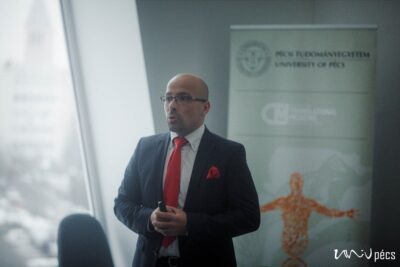
In Hungary, the translational mindset gained fresh momentum in 2016, when the first Translational Medicine Centre was established under the leadership of Professor Péter Hegyi at the University of Pécs. The initiative was supported by the Translational Medicine Foundation, which provided methodological foundations, digital infrastructure and an international network.
The model’s success soon grew to national scale: St George Hospital in Székesfehérvár and Heim Pál Children’s Hospital in Budapest also joined.
Semmelweis University CTM – at the forefront of Europe
Since its foundation in 2021, the Centre for Translational Medicine (CTM) of Semmelweis University has become one of Europe’s largest and fastest-growing TM centres. The Centre provides a platform where basic research, clinical care, education and data-driven innovation work closely together. Our goal is to set science in motion for healing, so that research results serve patient care not years later, but from the very moment they are produced.
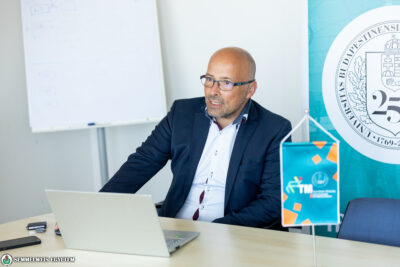
A key mission of the CTM is training the next generation of healthcare professionals. Students gain not only scientific knowledge but also hands-on experience, enabling them to make a direct impact on the quality of patient care.
International expansion – the future of the CTM
The translational medicine model will reach a new milestone in 2025:
• at the University of Szeged and
• at the Medical University of Vienna
PhD training as well as supervisor master training will be launched.
From 2026, with the professional support of the Centre for Translational Medicine of Semmelweis University, doctoral training in translational medicine will also be launched at the University of Pécs and Markusovszky Hospital in Szombathely.
This not only increases the programme’s international weight, but also allows students and lecturers to become part of a cross-institutional knowledge community – a scientific network that is already building tomorrow’s healthcare today.
Technological and research-support background
The CTM is not only an educational centre but also a resource hub supporting research:
- through the ECDMS system we work with reliable, validated healthcare data,
- we support studies with methodological, biostatistical, IT and AI expertise,
- and we play an active role in data-driven clinical innovation.
Strategic Partners
- Translational Medicine Foundation – provides an ECDMS IT system and e-learning materials to support scientific research, strengthening research infrastructure and digital training.
- National Biomedical Foundation – develops e-learning materials and recruits young researchers within the National Academy of Scientist Education programme, ensuring future scientific talent.
- University of Szeged, University of Pécs, Markusovszky Hospital in Szombathely & University of Vienna – key members of the international translational-medicine training network from 2025.
Healthcare Institutions Collaborating in the Hybrid PhD–Residency Programme
Student numbers are currently being updated.
- Borsod-Abaúj-Zemplén County Central Hospital and University Teaching Hospital
- Fejér County Szent György University Teaching Hospital
- Vas County Markusovszky University Teaching Hospital
- Budapest Bajcsy-Zsilinszky Hospital and Outpatient Clinic
- National Institute of Oncology
- Veszprém County Csolnoky Ferenc Hospital
- Békés County Central Hospital
- Somogy County Kaposi Mór Teaching Hospital
- Heves County Markhot Ferenc Teaching Hospital and Outpatient Clinic
- Bethesda Children’s Hospital of the Reformed Church in Hungary
- Jász-Nagykun-Szolnok County Hetényi Géza Hospital and Outpatient Clinic
- Bács-Kiskun County Teaching Hospital
- South Pest Central Hospital – National Institute of Hematology and Infectious Diseases
- Komárom-Esztergom County Szent Borbála Hospital
- Kistarcsa Flór Ferenc Hospital
- Kiskunhalas Semmelweis Hospital
- Nógrád County Szent Lázár Hospital
- Budapest Dr. Jenő Manninger Trauma Centre
- Vác Jávorszky Ödön Hospital
- National Korányi Institute of Pulmonology
- Dunaújváros Szent Pantaleon Hospital and Outpatient Clinic
- Nyírő Gyula National Institute of Psychiatry and Addictology
- Esztergom Vaszary Kolos Hospital
- Siófok Hospital and Outpatient Clinic
- Ajka Magyar Imre Hospital
- Szent Damján Greek Catholic Hospital
- Hungarian National Blood Transfusion Service
- Hévíz Szent András Hospital for Rheumatology and Spa
- Keszthely Hospital
- Józsefváros Szent Kozma Health Centre
- Szent Kozma and Damján Rehabilitation Specialist Hospital
- Tagore Medical Center
- Heim Pál National Pediatric Institute (the agreement will be signed at a later date)
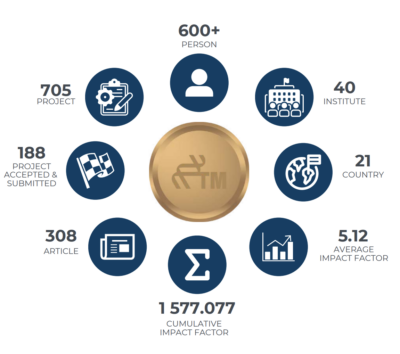
Results
The results from 2021 to 2025 speak for themselves:
Join us!
If you are looking for a community where science serves people rather than itself, the Centre for Translational Medicine is for you. Whether you are a student, lecturer, researcher or partner institution – the future of healthcare starts here, with you.
Contact: tmk@semmelweis.hu