Clinical Genetics
Clinical Genetics
Credit value: 2
Semester: 9th semester, 10th semester
Type of course: obligatory
Language of instruction: English
Course code: AOKGRI966_1A
Lecturer and Chairman of the Department: Prof. Dr. Mária Judit Molnár
Course Instructor: Dr. Viktor Molnár
Objective of instruction and its place in the curriculum:
The aim of the Clinical Genetics course is to familiarize medical students with the clinical significance of human genome variations and to teach them the fundamentals of diagnosing and managing genetic diseases. The course is centered around clinical cases and everyday medical situations, with special emphasis on the physician’s role in recognizing and managing inherited diseases and developing effective patient communication. During the two-week intensive course, students gain insight into the specific features of both pediatric and adult clinical genetics care. Genetics plays a crucial role in pediatrics, as many severe genetic disorders manifest in childhood, making their recognition and treatment an integral part of pediatric practice. In adult care, clinical genetics is increasingly important in the diagnostics and personalized treatment of neurogenetic disorders, hereditary cancer syndromes, and cardiogenetic conditions. The course not only introduces the diagnostic application of genetic testing but also emphasizes the preventive, predictive, and patient management roles of genetics. The impact of genetic knowledge ranges from supporting therapeutic decisions to shaping public health strategies—such as targeted screening in high-risk groups and the possibilities of newborn genetic screening. Particular attention is given to ethical and communication challenges, especially in situations specific to genetics—such as interpreting presymptomatic results or variants of uncertain significance. Clinical genetics is one of the most rapidly evolving fields in medicine and has become a transdisciplinary science. There is no area of medicine where recognizing and interpreting genetic factors is not relevant. Therefore, this course is a fundamental element of modern medical education and is essential in preparing future physicians for the era of personalized and data-driven medicine.
Method of instruction (lecture, group work, practical lesson, etc.): Seminars and practical sessions involving group work and the use of interactive educational materials.
Competencies acquired through completion of course: The presentation of disease models related to inherited disorders through real clinical situations, integrated into a problem-based learning framework, enhances students’ independent and group problem-solving abilities. Due to the extraordinary heterogeneity of inherited diseases, it is not our goal to comprehensively cover the entire subject matter during the two-week course. This is exactly what makes the course special: it offers students the opportunity to experience the process of problem-solving, overcoming new challenges, and successfully handling previously unknown situations. Problem-based learning not only maintains interest and makes the learning process enjoyable, but it also fosters professional development and the formation of a mindset for lifelong learning, which is essential in healthcare professions. After successfully completing the course, students will possess knowledge of the most common genetic and genomic predictive, preventive, diagnostic, and pharmacogenomic concepts. They will understand the purpose and methodology of genetic counseling and become familiar with the principles, professional guidelines, and ethical dilemmas involved in diagnostic and therapeutic decision-making.
In practice, students will learn how to: (1) identify clinically relevant family history and when to consider a genetic disorder, (2) select and interpret the most appropriate genetic tests, (3) ntegrate genomic information into treatment decision-making. Through various real and synthetic clinical cases, and direct involvement in outpatient and inpatient care, students will learn how to: (1) collect relevant information from various sources, (2) use artificial intelligence-based decision-support systems to recognize phenotypic patterns, (3) communicate with patients and their families living with inherited diseases in a counseling role, (4) collaborate in multidisciplinary teams while addressing real diagnostic challenges.
Prerequisites for course registration and completion: Pharmacology II. , Genetics and Genomics, Pathology II.
Detailed course syllabus: According to the syllabus, the course sessions follow the sequence outlined below for the Hungarian and foreign language student groups participating in the paediatric rotation of the 1st term. In the 2nd term, the order of the Clinical Genetics modules related to adult and paediatric care is reversed, as detailed in the attached schedule.
- The role of clinical genetics in patient care |90’| day 1 Institute of Genomic Medicine and Rare Disorders (GRI) — Prof.Dr. Molnár Mária Judit, Dr. Grosz Zoltán
- Outpatient/Inpatient unit |90’| day 1 GRI — Prof.Dr. Molnár Mária Judit, Dr. Varga Noémi Ágnes, Dr. Palásti Ágnes, Dr. Benedek Péter, Prof.Dr. Molnár Mária Judit
- Diagnostic strategies and interpretation of genetic test results |90’| day 2 GRI — Dr. Balicza Péter, Dr. Molnár Viktor
- Outpatient/Inpatient unit |90’| day 2 GRI — Dr. Grosz Zoltán, Dr. Szegedi Márta, Dr. Palásti Ágnes, Dr. Benedek Péter
- Personalized medicine and management of hereditary diseases |90’| day 4 GRI — Prof.Dr. Molnár Mária Judit, Dr. Csányiné Sági Judit
- Genetic counseling |90’| day 4 GRI — Dr. Szegedi Márta, Dr. Csendes Barbara
- Team competition |90’| day 4 GRI — Dr. Csendes Barbara, Dr. Molnár Viktor
- Dysmorphology (recognizing syndromes based on malformations) |45’| day 5 Gyer2 — Dr. Pinti Éva, Dr.Lengyel Anna
- Assessing the pathogenicity of copy number variations |45’| day 5 Pediatric Center Tűzoltó street unit — Dr. Pinti Éva
- Importance of tumor predisposition syndromes in childhood |45’| day 5 Pediatric Center Tűzoltó street unit — Dr. Pinti Éva, Dr.Lengyel Anna
- Relevance of identifying somatic variants in childhood malignancies |45’| day 5 Pediatric Center Tűzoltó street unit —Dr. Egyed Bálint, Dr. Erdélyi Dániel
- Role of genetics in pediatrics, distinguishing main childhood mechanisms |45’| day 6 Pediatric Center Bókay street unit — Dr. Tory Kálmán, Dr. Fekete Anett
- When to suspect a genetic disorder: pediatric spot diagnoses, mechanism and inheritance, ethical challenges |45’| day 6 Pediatric Center Bókay street unit — Dr. Tory Kálmán, Dr. Antal-Kónya Violetta
- Metabolic disorders associated with intoxication |45’| day 6 Pediatric Center Bókay street unit — Dr. Zsidegh Petra, Dr. Pálmay Andrea
- Inborn errors of metabolism with substrate deficiency and lisosomal storage disorders |45’| day 6 Pediatric Center Bókay street unit — Dr. Zsidegh Petra, Dr. Pálmay Andrea
- Chromatograms, analysis of QMPSF |45’| day 6 Pediatric Center Bókay street unit — Dr. Jávorszky Eszter, Némethi Zaránd
- Evaluating variant pathogenicity in pediatric practice |45’| day 6 Pediatric Center Bókay street unit —
- Ward practice (hereditary liver, kidney, intestinal, neurological diseases, malformations, presentation) |90’| day 7 Pediatric Center Bókay street unit — Dr. Fekete Anett
- Metabolic workshop |45’| day 7 Pediatric Center Bókay street unit — Dr. Kerti Andrea
- Pediatric ethical issues and research opportunities |45’| day 7 Pediatric Center Bókay street unit —
- Exam |30’| day 10
Requirements for attendance, options for making up missed sessions, and method of absence justification: According to the Academic and Examination Regulations, in the case of block teaching, obtaining the course signature requires participation in at least 90% of the organized practical sessions and seminars. This allows for absence from a maximum of one 90-minute and one 45-minute module. Make-up opportunities are available during an educational week agreed upon in advance with the academic coordinator.
Assessment methods during semester (number, topics, and dates of midterms and reports, method of inclusion in the course grade, opportunities for make-up and improvement of marks): Due to the short duration of the course, there will be no interim formal assessments. However, the interactive nature of the practical sessions and consultations provides opportunities to monitor students’ knowledge and the application of information, as well as to offer feedback. In certain sessions, questions may arise that presuppose familiarity with previously assigned background materials.
Number and type of individual assignments to be completed, submission deadlines: According to the flipped classroom model, independent preparation is required for certain sessions (The role of clinical genetics in patient care, Diagnostic strategies and interpretation of genetic test results, Personalized medicine and management of hereditary diseases), using the provided preparatory materials. During the solution of the tasks assigned to each student group, students will also familiarize themselves with half of the exam questions (not pre-published), which are related to the focus diseases (approximately 10 per course).
Requirements for the successful completion of the course: At least 90% attendance is required for course completion. Attendance is verified through registration combined with evaluation at the end of each session. The link required for the evaluation is provided in a shared document sent via the Neptun system to group members during the week prior to the course.
Type of assessment: terminal examination
Exam requirements (list of topics, topics of the test exam, and the optional project topics accepted as an exam) Successful completion of the course requires obtaining the course signature (with no more than 10% absence, including make-up sessions) and passing the written exam. The exam includes problemand practice-oriented questions that comprehensively cover the course curriculum. In accordance with §30 of Senate Resolution 26/2025. (III.27.) (53720/AOADH/2025), which governs course requirements for the 2025/2026 academic year, the written test includes only written tasks, and both the test questions and corresponding answers are made available to all students in advance.
Clear, specific minimum requirements for assessment. (The list of mandatory concepts, parameters, diagrams, calculations, and practical skills required to obtain a passing grade, as well as the criteria for the completion and evaluation of project assignments accepted as an exam.) A link published on the department’s website referring to the minimum requirements of the course. Description and minimum assessment requirements for the Clinical Genetics course: https://semmelweis.hu/genomikai-medicina/en/education/clinical-genomics-i/
Method and type of grading: The written test consists of 30 multiple-choice questions, with a total of 100 points available. Grading is based on the following scale: 90% and above: Excellent (5) 80–89%: Good (4) 70–79%: Satisfactory (3) 60–69%: Pass (2) Below 60%: Fail (1)
During the written test, students are expected to demonstrate not only their theoretical knowledge but also its practical application.
List of coursebooks, textbooks, study aids and literature facilitating the acquisition of knowledge to complete the course and included in the assessment, precisely indicating which requirement each item is related to (e.g., topic by topic) as well as a list of important technical and other applicable study aids; possibility of individual or group student consultation, if available:
Online resources:
|
Required |
Link |
Title |
|
Yes |
Assignments and background material published on the course Moodle site. |
|
Required |
Author |
Title |
Publisher |
Year of publication |
|
Recommended |
Peter D Turnpenny, Sian Ellard, Ruth Cleaver |
Emery’s Elements of Medical Genetics and Genomics |
Elsevier |
2020 |
Klinische Genetik
Klinische Genetik
NEPTUN-Code: AOKGRI764_1N
Kontaktinformationen
Kursleiter: Dr. Viktor Molnár
Dozent und Vorsitzender der Abteilung: Prof. Dr. Mária Judit Molnár
Anfragen in Bezug auf Studienangelegenheiten sind an die E-Mail-Adresse von Andrea Tóth, Leiterin des Sekretariats, gerichtet, die sie an die entsprechende Person weiterleitet:
E-Mails müssen den vollständigen Namen und den NEPTUN-Code der Studenten enthalten.
Lernveranstaltungen
Datum: gemäß Blockplanung (NEPTUN)
Standorte und Unterricht:
- Eröffnungsvorlesung, weitere Seminare und Workshops:
Elméleti Orvostudományi Központ – EOK
(Medizinisches Grundwissenschaftszentrum)
Seminarraum 0.806
1094 Budapest, Tűzoltó Str. 37-47.
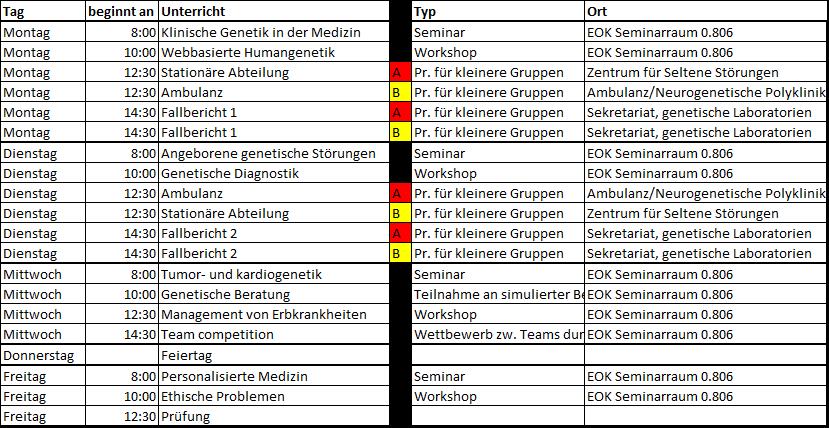
- Praktiken für kleinere Gruppen (Ambulanz, stationäre Abteilung und Fallbericht 1&2):
Die Praktikumsleiter werden die Studenten zu den richtigen Orten begleiten.
Treffpunkt: Haupteingang, Erdgeschoss, hinter der Rolltreppe, wo sich Umkleideraum und Schließfächer befinden.
Korányi Tömb, Központi Betegellátó Épület, KBE
(Zentrale Patientenversorgungseinheit der Uni Semmelweis)
1082 Budapest, Üllői Str. 78 / B.
Schutzkleidung ist für Praktiken in kleinen Gruppen in der stationären Abteilung und Ambulanz obligatorisch. Die Studenten erhalten nach der Hinterlegung ihrer Studentenausweise weiße Kittel und Schließfachschlüssel. (Herr Boldizsár Viola erwartet die Studenten 20 Minuten vor und nach den Praktiken für kleinen Gruppen, die am Montag und Dienstag von 12.30 bis 16.00 Uhr veranstaltet werden. Bitte verspäten Sie nicht!
Zur Information die drei Standorte:
Ambulanz/Neurogenetische Polyklinik:
Korányi Tömb, Központi Betegellátó Épület, KBE
(Zentrale Patientenversorgungseinheit der Uni Semmelweis)
1082 Budapest, Üllői Str. 78 / B.
Gebäude „B” (Hauptgebäude) 1. Stock
(Wenn Sie von der Richtung der Üllői-Straße am Haupteingang hereinkommen, fahren Sie mit der Rolltreppe in den ersten Stock, vorbei an der Apotheke und dem Buffet, im runden Wartezimmer rechts und betreten einen kurzen Korridor – Zimmer 148. und 149. Sie können auch roten Pfeilen mit dem Namen unseres Instituts folgen die Richtung.)
Sekretariat, genetische Laboratorien:
(auch im Gebäude „Korányi Tömb“)
Gebäude „A” (Radiologie-flügel) 4. Stock
Hier befindet sich die Büros von Institut für Medizinische Genomik und seltene Erkrankungen (ung: Genomikai Medicina és Ritka Betegségek Intézete).
Stationäre Abteilung:
Zentrum für Seltene Störungen (ung. Ritka Betegségek Központ)
Uniklinik Neurologie – rechter Flügel, 1. Stock
1083 Budapest Balassa János Str. 6.
(Die Studenten können die Abteilung über den hoch laufenden verglasten Korridor erreichen, der die Kliniken verbindet. Der barrierefreie Zugang erfolgt über den Eingang des Krankenwagens.)
Weitere Studienangelegenheiten:
Kreditpunkte: 2
Anwesenheitsvoraussetzungen und Ausgleich von Abwesenheiten: Die Teilnahme an 75% der Unterrichte ist das Mindestkriterium für die Erlangung der Unterschrift.
Vorfächer: Pharmakologie II, Genetik und Genomik, Pathologie II
Prüfungsform: schriftliche Prüfung
Anmeldung zur Prüfung: NEPTUN
Nützliche Lernmaterialien: Moodle
Überblick über das einwöchige Blockpraktikum: