The Laboratory for Immunology and Tumor Microenvironment is an in situ imaging-based research group in the Department of Anatomy, Histology and Embryology. Our core mission is to understand how the tumor microenvironment (TME)—tumor cells, immune cells, stroma, vessels and their spatial arrangement—shapes tumor progression and the response or resistance to immunotherapies.
A central concept in modern TME research is that “where cells are” can be as important as “which cells are present.” Therefore, we focus on spatial biology and morphology-driven mapping of human tumor tissue. Using high-resolution histology, multiplex immunostaining and digital pathology, we quantify immune infiltration patterns, antigen-presentation status, stromal architecture, hypoxia-associated niches, and tumor–immune interfaces. We integrate these spatial readouts with clinical outcome data and, when available, systemic immune measurements.
We also study how microbes influence anti-tumor immunity, both indirectly through the gut microbiome and, in selected settings, through intratumoral bacterial signals and microbe-derived products (including bacterial extracellular vesicles). Beyond “molecular mimicry,” we evaluate broader mechanisms such as immune priming, myeloid programming, barrier-linked inflammation, and microbial metabolites.
Our primary disease focus is lung cancer, where improved predictive and prognostic biomarkers are urgently needed to support earlier detection and better therapy selection. The lab operates within a translational network, collaborating with in vitro and clinical teams to move from tissue-level mechanisms to clinically useful signatures and targets.
It is possible to join the research group’s work as part of a TDK or PhD program.
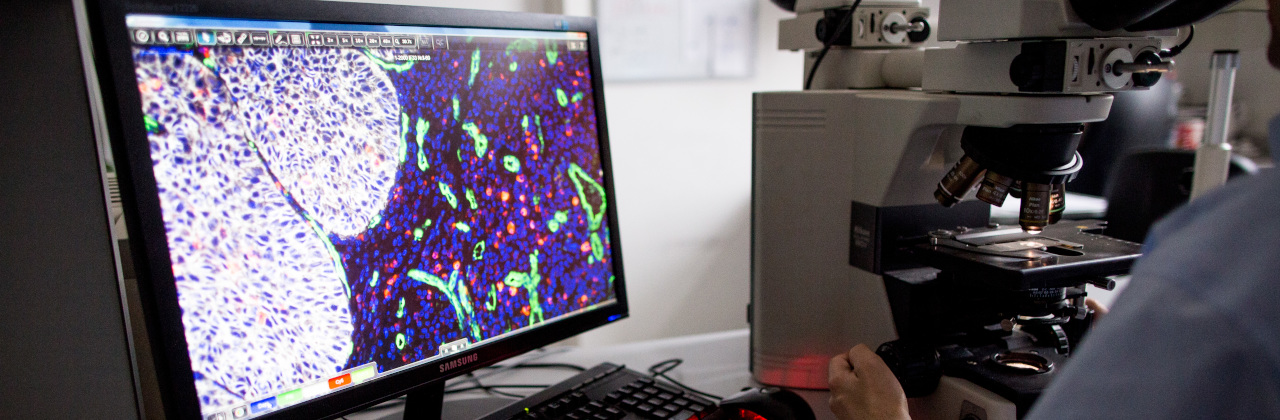
Key research pillars
- Spatial TME mapping rooted in anatomy/histology
- Quantitative digital pathology and morphometrics
- Immunotherapy-relevant immune and stromal archetypes
- Gut–tumor immune crosstalk and intratumoral bacterial hypotheses
- Biomarker discovery in lung cancer cohorts
Funding
- NKFIH OTKA-FK (2023) “The role of the gut microbiome and microbiota-derived urine metabolites in the activation of macrophages and T-cells in the context of anti-tumor immunity”; ID: 146775; Period: 2024.01.01.-2027.12.31. Funding: 43.666K HUF
- Marie Skłodowska-Curie Action – Horizon Europe framework programme: MiCCrobioTackle 2024 (grant agreement No. 101169068)